
Packing a Personal Health Kit: What's Worth Carrying vs. What Wastes Space

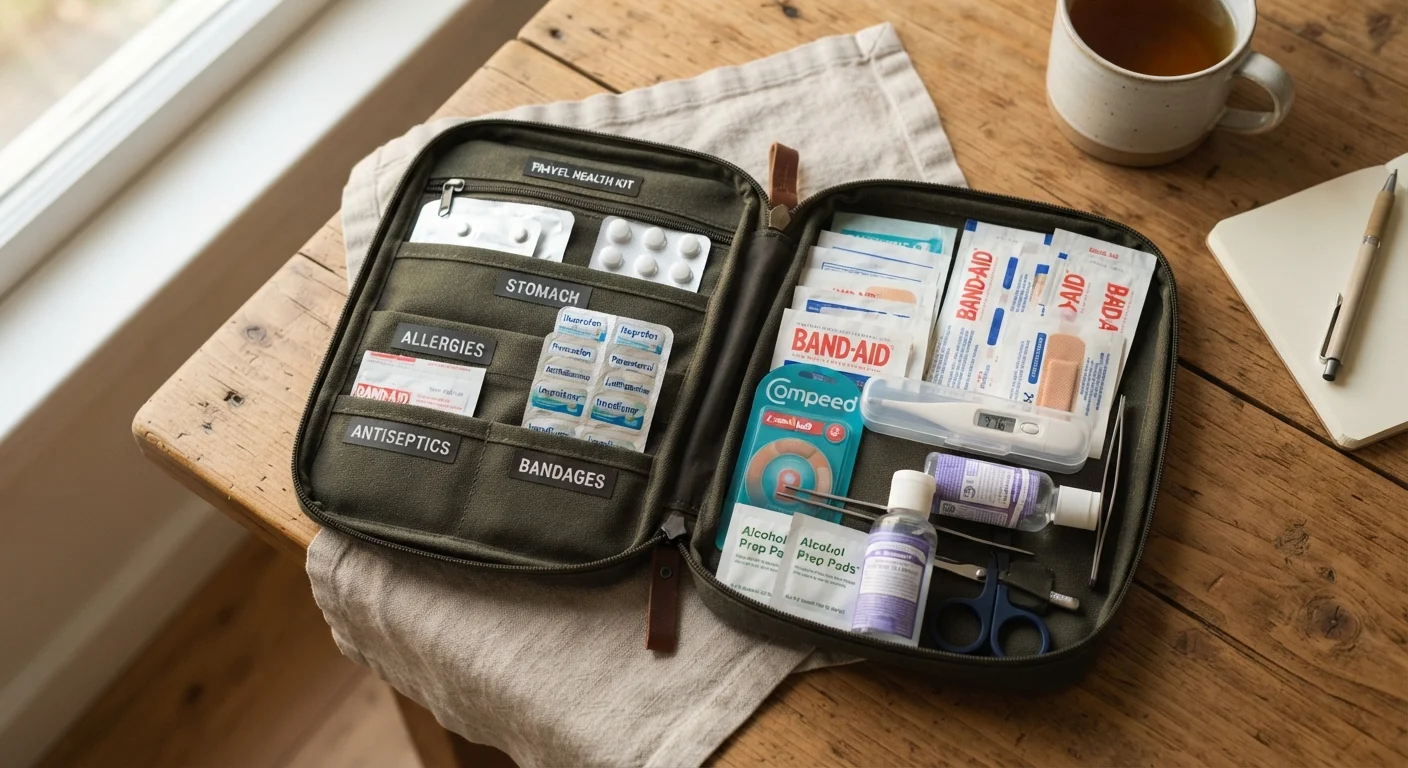
Photo: DockedReads.com | Information Made Easy editorial
Key Takeaways
- A lean health kit focused on your trip type and personal needs beats a bloated generic first-aid box.
- Prescription medications, blister care, and basic pain relievers consistently earn their weight for most travelers.
- Bulky items like full-size antiseptic bottles and rarely-used supplies are common space wasters.
- Always verify vaccination and medication requirements with official health authorities before traveling internationally.
- General health information here is educational — consult a healthcare provider for personal medical guidance.
Handles minor issues before they become trip-enders
A blister, a headache, or a bout of traveler's diarrhea can derail an entire day if you're unprepared. Having the right supplies on hand lets you address problems quickly and keep moving.
Provides reassurance in low-resource environments
In rural destinations or developing regions, pharmacies may be scarce, products unfamiliar, or language barriers significant. A personal kit removes that uncertainty.
Tailored kits outperform generic pre-made options
Building your own kit means every item reflects your health profile and trip type — no dead weight from supplies you'll never use and won't encounter needing.
Prescription continuity is entirely in your control
Carrying your own medications with written documentation means you're not dependent on finding a specific drug abroad, where names, formulations, and availability differ widely.
One kit can serve multiple purposes
Items like antihistamines double as allergy and motion sickness relief; electrolyte packets support hydration in heat as well as illness recovery — efficient multipurpose items reduce overall volume.
Over-packing adds meaningful weight and bulk
A poorly curated kit can easily add a pound or more to your bag — weight that accumulates across long travel days and competes with more essential items.
False security can delay appropriate care
Travelers who feel fully equipped sometimes manage symptoms at arm's length when they should be seeking proper medical evaluation. A health kit is a bridge, not a substitute for professional care.
Many items are readily available at destinations
Pain relievers, antacids, and basic bandages are sold at pharmacies and convenience stores worldwide. Carrying redundant versions of these wastes space you could use more wisely.
Liquid and sharp items create security screening friction
Antiseptic gels, liquid medications, and lancets or syringes require careful compliance with carry-on regulations that vary by airline and country — adding pre-flight administrative complexity.
Why a Health Kit Is Worth Having at All
There's a particular kind of frustration that comes with being three hours from a pharmacy when a blister turns into a hobbling problem, or when a headache builds during a long overnight train ride and you have nothing to take. A personal health kit doesn't promise to handle every scenario — but it closes the gap between a manageable minor setback and a day-ruining ordeal.
The case for carrying one isn't about anxiety or over-preparation. It's about the basic arithmetic of travel: you're more likely to be far from familiar resources exactly when you need them. This applies whether you're hiking a national park trail or navigating a dense urban itinerary abroad. As part of a well-planned trip, health preparation sits alongside documents, finances, and logistics — not as an afterthought, but as a quiet form of confidence.
Handles minor issues before they become trip-enders
A blister, a headache, or a bout of traveler's diarrhea can derail an entire day if you're unprepared. Having the right supplies on hand lets you address problems quickly and keep moving.
Provides reassurance in low-resource environments
In rural destinations or developing regions, pharmacies may be scarce, products unfamiliar, or language barriers significant. A personal kit removes that uncertainty.
Tailored kits outperform generic pre-made options
Building your own kit means every item reflects your health profile and trip type — no dead weight from supplies you'll never use and won't encounter needing.
Prescription continuity is entirely in your control
Carrying your own medications with written documentation means you're not dependent on finding a specific drug abroad, where names, formulations, and availability differ widely.
One kit can serve multiple purposes
Items like antihistamines double as allergy and motion sickness relief; electrolyte packets support hydration in heat as well as illness recovery — efficient multipurpose items reduce overall volume.
What Actually Earns Its Weight
The items most consistently useful across trip types share a common trait: they address problems that are both common and genuinely uncomfortable to wait out. Blister pads and moleskin top that list for any trip involving sustained walking. A small supply of pain relievers — whether ibuprofen or acetaminophen — is almost universally useful. Anti-diarrheal tablets and oral rehydration salts are compact, rarely needed, and indispensable when they are.
For travelers with personal prescriptions, those medications are obviously non-negotiable. Beyond the medication itself, carrying a written copy of each prescription (with generic drug names) is a practical safeguard if you need a replacement abroad. Antihistamines cover both allergy flare-ups and motion sickness for many people — one item doing double duty, which is the gold standard for kit efficiency.
Altitude considerations, insect-borne illness risks, and destination-specific health concerns are all worth discussing with a healthcare provider before you travel. The pre-trip health checklist is a useful starting point for that conversation. For solo travelers especially, preparation matters more — there's less of a built-in safety net when something goes sideways, as explored in depth for solo traveler health safety.
A Note on Destination-Specific Requirements
What's More Likely to Waste Space
The most common kit-bloating offenders are items packed from habit or vague anxiety rather than trip-specific logic. Full-size antiseptic bottles are a classic example: a small wound-cleaning wipe achieves the same result in a fraction of the space. Elastic bandages and cold packs are bulk items that most urban travelers will never use — and are generally available locally if needed.
Duplicate items are another quiet weight culprit. Many travelers pack both a thermometer and a separate fever patch, or bring both antacid tablets and liquid antacid. Choose one form that works for you. Heavy item-by-item first aid kits marketed as travel essentials often include supplies suited to wilderness emergencies — items irrelevant if you're staying in cities or resort areas with accessible medical care.
Over-packing adds meaningful weight and bulk
A poorly curated kit can easily add a pound or more to your bag — weight that accumulates across long travel days and competes with more essential items.
False security can delay appropriate care
Travelers who feel fully equipped sometimes manage symptoms at arm's length when they should be seeking proper medical evaluation. A health kit is a bridge, not a substitute for professional care.
Many items are readily available at destinations
Pain relievers, antacids, and basic bandages are sold at pharmacies and convenience stores worldwide. Carrying redundant versions of these wastes space you could use more wisely.
Liquid and sharp items create security screening friction
Antiseptic gels, liquid medications, and lancets or syringes require careful compliance with carry-on regulations that vary by airline and country — adding pre-flight administrative complexity.
The principle behind smart packing broadly applies here: every item should justify its presence based on likelihood of use and inability to source locally. For a broader take on that mindset, the packing principles that hold up across every trip is worth reading alongside this guide.
~50%
Travelers who experience GI illness abroad
Traveler's diarrhea is estimated to affect roughly 30–70% of international travelers depending on destination, according to the CDC's traveler health resources.
Top 3
Most common traveler health complaints
Gastrointestinal illness, respiratory infections, and skin conditions (including blisters and sunburn) consistently rank among the most frequently reported travel health issues.
Building a Kit That Fits Your Trip
The most effective health kit is assembled backwards from your itinerary, not forward from a generic list. A weekend city trip calls for very different contents than a three-week backpacking journey through rural terrain. Ask yourself: How far will I be from pharmacies or clinics? What activities am I doing? Do I have any personal health conditions that need active management on the road?
Trip duration matters too. For short trips, a stripped-down kit is almost always the right call. For longer journeys or group travel — where someone in your party will inevitably need something — a slightly more comprehensive kit can serve multiple people. That shared-resource logic is one of the underappreciated trade-offs of group travel worth thinking through in advance.
Before finalizing anything, cross-reference your kit against the full pre-travel checklist to make sure health prep fits within your broader departure preparation. And if you have any specific medical concerns, consult a qualified healthcare provider — the decisions worth making carefully are the ones that actually matter to your safety.
This article is for general informational purposes only and does not constitute medical advice. Always consult a qualified healthcare professional regarding your personal health needs before traveling.
The content on this site is for informational purposes only and is not a substitute for professional advice. Always consult a qualified professional for guidance specific to your situation.