
Speed Limits, Stopping Distances, and the Physics Most Drivers Ignore

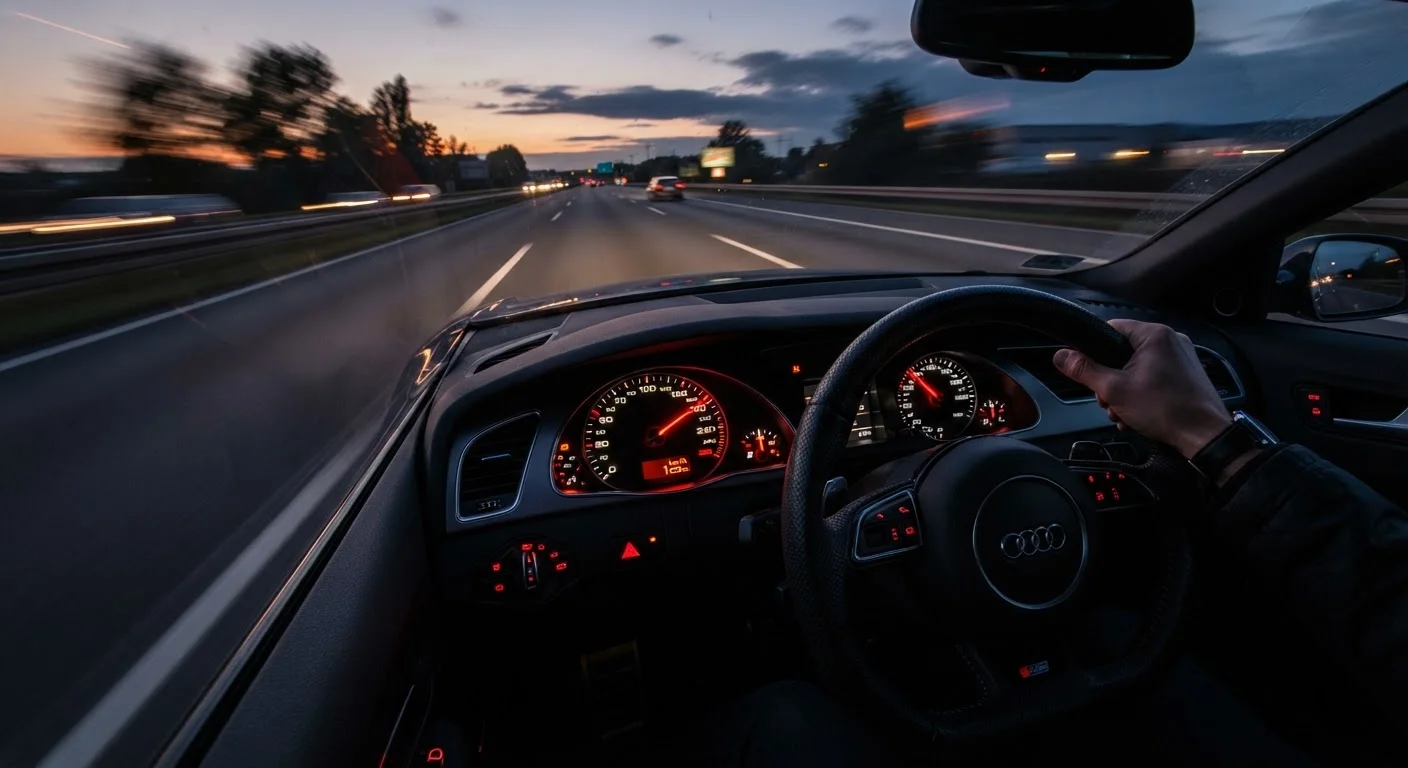
Photo: DockedReads.com | Information Made Easy editorial
Key Takeaways
- Doubling your speed quadruples braking distance — the relationship is exponential, not linear.
- Reaction time typically adds 1–2 seconds of travel distance before brakes engage at all.
- Wet, icy, or worn-tire conditions can multiply stopping distances significantly beyond dry-road baselines.
- Speed limits are set with average road and reaction conditions in mind — they are not a guaranteed safety margin.
- Increasing following distance is one of the most effective ways to compensate for longer stopping distances at higher speeds.
Why Speed and Stopping Distance Don't Scale the Same Way
Most drivers understand that going faster means needing more room to stop. What many underestimate is how much more. Stopping distance does not increase proportionally with speed — it grows with the square of your speed. This is a direct consequence of kinetic energy: a moving vehicle stores energy proportional to speed squared, and all of that energy must be dissipated through braking before the car stops.
A practical illustration: at 30 mph, a typical passenger car on dry pavement needs roughly 75 feet to stop (reaction plus braking). At 60 mph — double the speed — the stopping distance is not 150 feet but closer to 240 feet or more. At 90 mph, it stretches to well over 500 feet. That's nearly the length of two football fields.
This exponential relationship is why small speed reductions near hazards — schools, intersections, merge zones — have an outsized safety effect. Slowing from 40 to 30 mph doesn't just trim 10 mph off your speed; it meaningfully cuts the kinetic energy your brakes must absorb.
4×
Braking distance multiplier when speed doubles
This reflects the kinetic energy equation (KE = ½mv²) — a well-established principle of classical mechanics applied to vehicle dynamics.
88 ft/sec
Distance traveled per second at 60 mph
At highway speeds, even a one-second reaction delay adds nearly a full car length of travel before braking begins.
8–10×
Stopping distance increase on ice vs. dry pavement
Ice dramatically reduces tire-road friction, meaning stopping distances used for dry conditions are dangerously insufficient in winter driving.
The Two-Part Reality: Reaction Distance Plus Braking Distance
Total stopping distance has two distinct phases that drivers often conflate. The first is reaction distance — how far your car travels between the moment you perceive a danger and the moment your foot actually engages the brakes. At 60 mph, you're covering 88 feet per second. A one-second reaction time — considered average for an alert, unimpaired driver — means 88 feet of travel before braking even begins.
Fatigue, distraction, and alcohol or medication all extend reaction time measurably. A reaction time of 1.5 seconds at 60 mph adds 132 feet before the brake pedal moves. That gap between seeing and responding is invisible in the moment but consequential in outcomes.
The second phase, braking distance, is where physics takes over. This depends on your speed (squared), tire condition, road surface, and brake system performance. Worn tires on wet pavement, for example, can push braking distance well beyond what the same vehicle achieves on dry roads with fresh rubber. See our guide to brake pad and rotor wear for insight into how maintenance affects this directly.
Add Seconds, Not Just Distance
What Speed Limits Don't Tell You
Posted speed limits represent the legally permitted maximum under favorable conditions — dry roads, clear visibility, well-maintained vehicles. They are not designed as a real-time guide that adjusts for rain, fog, school dismissal traffic, or driver fatigue. That judgment is left entirely to the driver.
This is especially critical in adverse weather. Stopping distances on ice can be eight to ten times those on dry pavement at the same speed. Driving in fog, ice, and high winds demands recalibrating your entire speed and following-distance strategy — the speed limit sign on the road doesn't change when conditions do.
Urban environments add another dimension. At city speeds of 20–25 mph, pedestrians struck by vehicles survive the overwhelming majority of collisions. At 40 mph, survivability drops sharply. This is the evidence base behind reduced speed zones near schools and residential areas — not bureaucratic caution, but documented physics translated into policy.
Speed Limits Assume Ideal Conditions
Translating Physics Into Everyday Driving Decisions
Understanding the physics is only useful if it shapes behavior. The most practical application is following distance. Because stopping distances grow faster than speed, the two-second following-distance rule — recommended for dry conditions at moderate speeds — should be extended to three or four seconds on wet roads, and more on ice or in reduced visibility.
Speed selection before entering curves, crests, or intersections also matters. Slowing before a hazard rather than during it keeps braking forces manageable and preserves steering control. This is a core tenet of defensive driving — anticipating where you might need to stop rather than reacting when you have to.
Finally, consider that stopping distance assumes the vehicle is mechanically sound. Worn brake pads, underinflated tires, or degraded shock absorbers all extend real-world stopping distances beyond textbook numbers. Keeping your vehicle maintained is not just an administrative task — it directly determines how much stopping distance those physics calculations actually reflect.
Frequently Asked Questions
The content on this site is for informational purposes only and is not a substitute for professional advice. Always consult a qualified professional for guidance specific to your situation.