
DIY Car Maintenance vs Letting a Mechanic Handle It

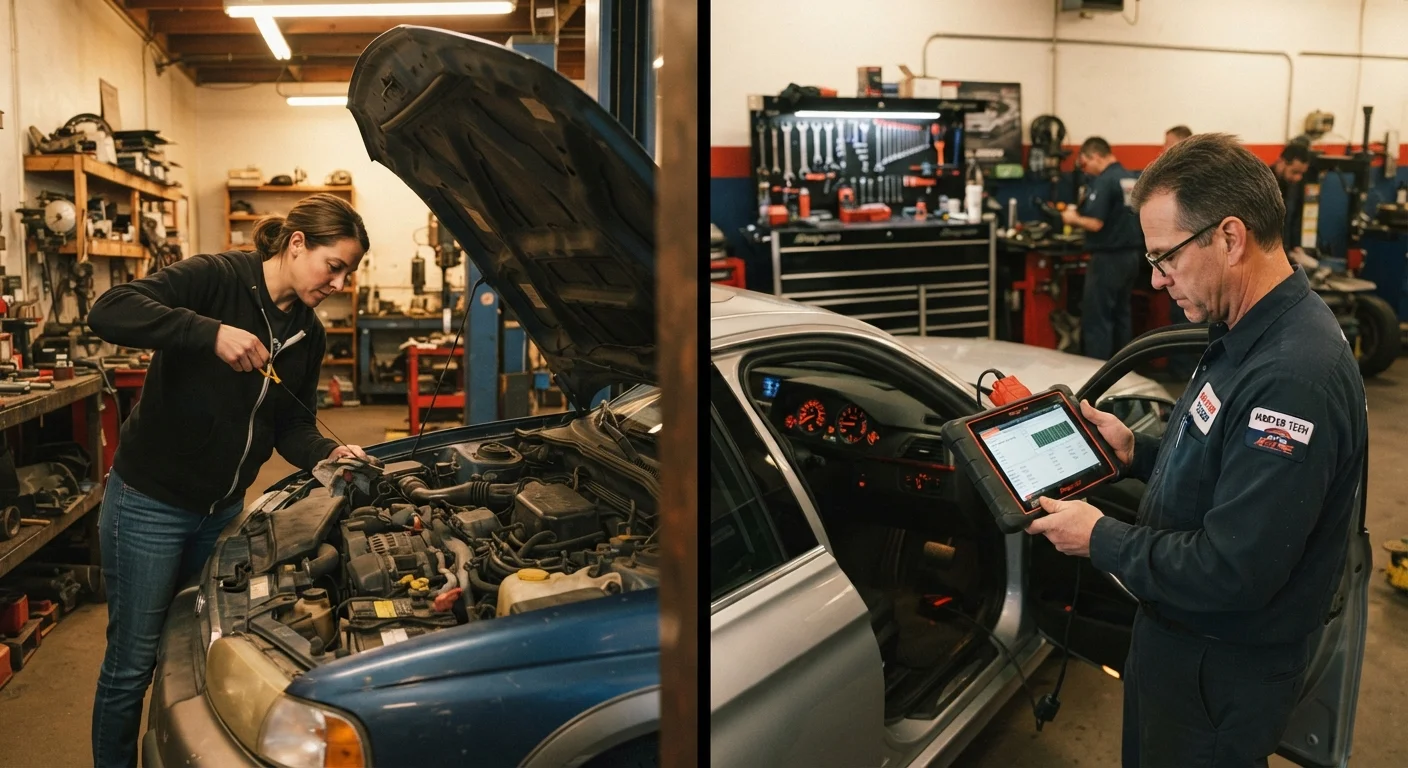
Photo: DockedReads.com | Information Made Easy editorial
Key Takeaways
- Simple tasks like fluid checks, air filters, and wiper blades are well within reach for most drivers.
- Work involving brakes, suspension, or safety-critical systems carries real risk if done incorrectly.
- Newer vehicles with complex electronics often require dealer-level diagnostic tools.
- DIY maintenance on a vehicle under warranty may affect coverage if not documented properly.
- The right choice depends on your skill level, available tools, and the specific job at hand.
Saves money on routine, low-complexity tasks
Straightforward jobs like air filter swaps, wiper blade replacement, and fluid top-offs cost a fraction of shop labor rates when done at home with basic tools.
Builds genuine understanding of your vehicle
Performing your own inspections means you notice changes in fluid color, hose condition, or component wear before they become expensive failures.
Flexible scheduling with no wait times
Home maintenance happens on your schedule — no appointment slots, no waiting rooms, and no transportation logistics to arrange.
Control over parts quality and specification
You choose exactly which fluids, filters, and components go into your vehicle, and can verify they meet manufacturer specifications directly.
Safety-critical errors carry serious consequences
Mistakes on brakes, suspension, or steering systems can compromise vehicle control. Unlike a stripped bolt, these errors may not be immediately obvious until the vehicle is in motion.
Modern vehicles require specialized diagnostic tools
Electronic systems in newer cars often cannot be properly reset or calibrated without OBD-II scan tools or dealer-level software, limiting what a home mechanic can realistically complete.
Tool investment offsets savings on infrequent jobs
A full set of quality jack stands, torque wrenches, and specialty sockets represents a significant upfront cost that may not recoup itself for the average single-car household.
Improper work may complicate warranty claims
While federal law offers some protection, a DIY repair that contributes to a covered component failure gives manufacturers grounds to dispute related warranty claims.
Disposal and environmental compliance add friction
Used motor oil, coolant, and brake fluid require proper disposal at designated collection sites — an extra step most shops handle automatically.
Where the DIY Line Actually Falls
The decision to handle a maintenance task yourself or hand it to a professional isn't about pride — it's about honestly assessing three things: the complexity of the job, the tools required, and the consequences of a mistake. Most drivers can safely handle a surprisingly wide range of tasks, while others require specialist equipment or training that makes DIY genuinely dangerous.
Routine upkeep like checking and topping off fluids, replacing cabin air filters, swapping wiper blades, or changing a flat tyre sits firmly in the accessible category. These jobs are covered in detail in most owner's manuals and require only basic tools. For a guided walkthrough of fluid checks, see Fluid Checks Every Driver Should Know How to Do.
Tasks involving brake components, wheel alignment, timing systems, or advanced diagnostics are a different matter. An error here doesn't just mean a repeat trip to the shop — it can compromise vehicle safety for everyone on the road.
Saves money on routine, low-complexity tasks
Straightforward jobs like air filter swaps, wiper blade replacement, and fluid top-offs cost a fraction of shop labor rates when done at home with basic tools.
Builds genuine understanding of your vehicle
Performing your own inspections means you notice changes in fluid color, hose condition, or component wear before they become expensive failures.
Flexible scheduling with no wait times
Home maintenance happens on your schedule — no appointment slots, no waiting rooms, and no transportation logistics to arrange.
Control over parts quality and specification
You choose exactly which fluids, filters, and components go into your vehicle, and can verify they meet manufacturer specifications directly.
The Real Costs — Tools, Time, and Warranty
One of the most common miscalculations in DIY maintenance is underestimating the upfront investment. A single oil change requires a drain pan, a filter wrench, jack stands, and proper disposal of used oil. Over time those tools pay off — but for someone doing one oil change per year on one vehicle, the arithmetic may not favor going it alone.
$80–$150/hr
Typical independent shop labor rate
Labor rates at U.S. independent auto repair shops generally fall in this range, with dealership service centers often billing higher per industry surveys.
3 of 4
Maintenance tasks accessible without a lift
Industry educators commonly note that a majority of scheduled maintenance items — filters, fluids, belts on accessible engines — can be performed safely with basic equipment and a stable flat surface.
Warranty considerations add another layer. Most new vehicle warranties in the U.S. are governed by federal Magnuson-Moss Warranty Act protections, which generally mean a manufacturer cannot void a warranty simply because you performed your own oil change — provided you used specification-correct fluids and parts and kept receipts. However, if an improperly performed DIY repair contributes to a covered component failing, the claim may be denied. When in doubt, keep thorough records and consult your warranty documentation.
Labor rates at independent shops typically range from $80 to $150 per hour, while dealer service centers often run higher. For complex multi-hour jobs, that gap between DIY cost and shop cost grows quickly — which is where intermediate-skill tasks like spark plug replacement or battery swaps can genuinely pay off for the prepared home mechanic.
When the Mechanic Is the Right Call
Modern vehicles are substantially more complex than those of even fifteen years ago. Brake pad replacement on a vehicle with electronic parking brakes, for instance, requires a scan tool to retract the caliper pistons — a step that cannot be safely skipped with basic hand tools. Similarly, many routine service resets (oil life monitors, tire pressure system relearns) require OBD-II scan tools beyond basic code readers.
Electronic Parking Brakes Require a Scan Tool
Safety-critical systems — brakes, steering, suspension, airbag wiring — should be treated with particular caution. Even experienced home mechanics often defer these to shops with alignment racks, hydraulic lifts, and the liability coverage to back their work. If an error occurs in these systems, the consequences extend beyond your vehicle to other road users.
When you do visit a shop, go in informed. Understanding what you're being asked to approve — and what the line items on an estimate actually mean — is its own skill. Reading a Mechanic's Estimate Without Getting Lost walks through exactly that process.
Safety-critical errors carry serious consequences
Mistakes on brakes, suspension, or steering systems can compromise vehicle control. Unlike a stripped bolt, these errors may not be immediately obvious until the vehicle is in motion.
Modern vehicles require specialized diagnostic tools
Electronic systems in newer cars often cannot be properly reset or calibrated without OBD-II scan tools or dealer-level software, limiting what a home mechanic can realistically complete.
Tool investment offsets savings on infrequent jobs
A full set of quality jack stands, torque wrenches, and specialty sockets represents a significant upfront cost that may not recoup itself for the average single-car household.
Improper work may complicate warranty claims
While federal law offers some protection, a DIY repair that contributes to a covered component failure gives manufacturers grounds to dispute related warranty claims.
Disposal and environmental compliance add friction
Used motor oil, coolant, and brake fluid require proper disposal at designated collection sites — an extra step most shops handle automatically.
Building a Smarter Maintenance Habit
The most effective approach for most drivers is a hybrid one: take ownership of low-risk, high-frequency tasks while building a relationship with a trustworthy mechanic for the rest. Keeping a simple maintenance log — noting dates, mileage, and what was done or inspected — gives you a clear picture of your vehicle's health regardless of who performed the work.
It's also worth understanding that deferred maintenance, whether DIY or professional, creates compounding costs. A $15 cabin air filter ignored for two years doesn't stay a $15 problem. Why Skipping Routine Maintenance Usually Costs More in the End explains the mechanical logic behind that pattern in detail.
Finally, separate fact from habit. Many maintenance intervals people follow — like oil changes every 3,000 miles — are outdated for modern engines and full synthetic oils. Car Maintenance Myths That Waste Money and Time covers several of these persistent misconceptions that quietly drain driver budgets. Your owner's manual remains the single most authoritative source for what your specific vehicle actually needs.
The content on this site is for informational purposes only and is not a substitute for professional advice. Always consult a qualified professional for guidance specific to your situation.