
Training Across Species: Dogs, Cats, Birds, and Small Mammals Compared

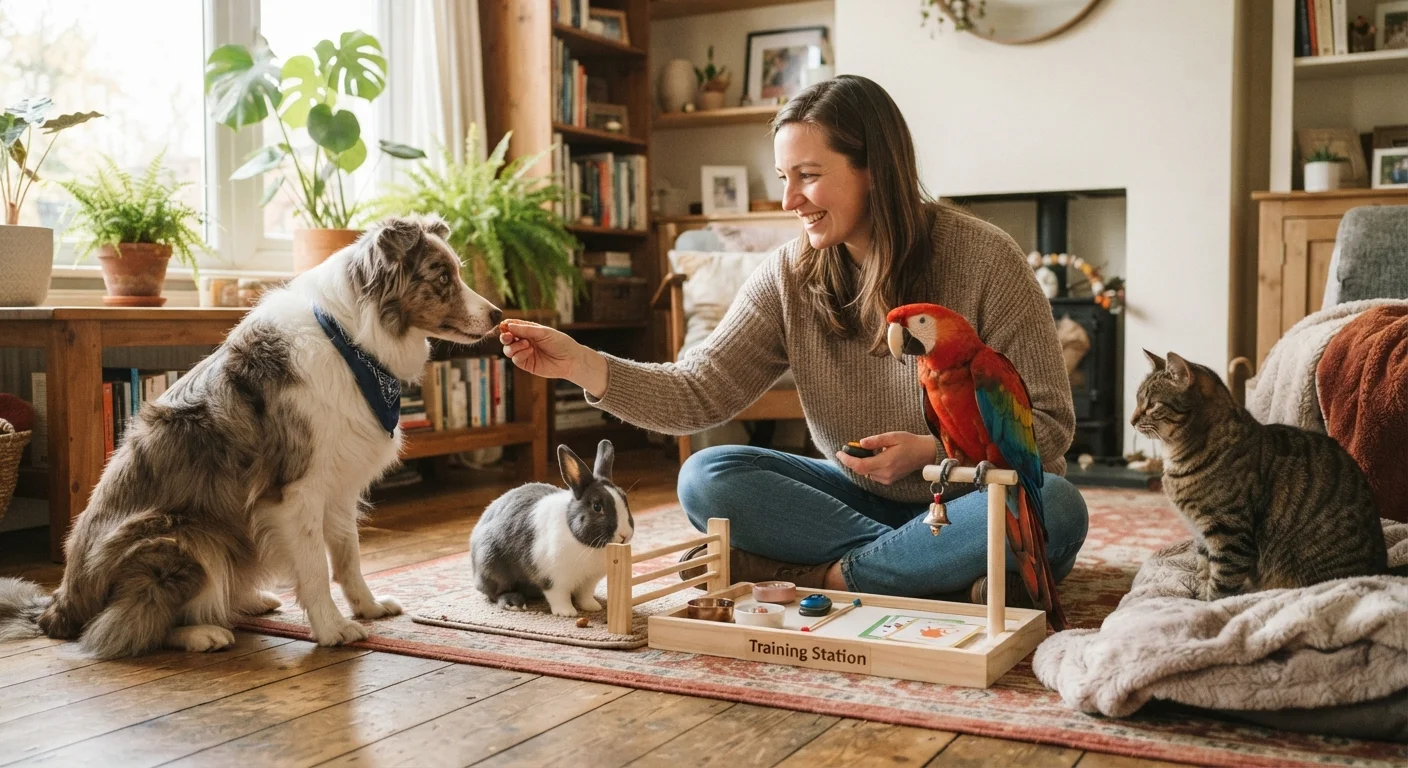
Photo: DockedReads.com | Information Made Easy editorial
Key Takeaways
- Dogs are generally the most responsive to structured training due to their social nature and motivation to cooperate with humans.
- Cats can be trained effectively using positive reinforcement, but sessions must be short, voluntary, and reward-driven.
- Birds — especially parrots — are highly intelligent and capable of complex learning, though they require patient, consistent methods.
- Small mammals like rabbits and guinea pigs respond to operant conditioning but have lower stress tolerance and shorter attention spans.
- Motivation type (food, play, social approval) varies significantly by species and even by individual animal.
Why Species Differences Matter in Training
Training any pet is ultimately about communication — and every species communicates, perceives reward, and processes new information differently. Understanding those differences isn't just an academic exercise; it directly shapes whether your sessions succeed or frustrate both you and your animal.
The foundational principles of pet training — reinforcement, timing, and consistency — apply across all species. What changes is how you deliver them. A training approach that works beautifully for a Labrador may be entirely ineffective, or even stressful, for a guinea pig or a cockatiel. Recognizing that each animal has evolved distinct social structures, sensory strengths, and motivational systems is the starting point for any species-appropriate training plan.
| Dogs | Cats | Birds | Small Mammals | |
|---|---|---|---|---|
| Social motivation | Very high | Low to moderate | Moderate to high | Low to moderate |
| Primary reward type | Food, play, praise | Food only (usually) | Food, social interaction | Food treats |
| Typical session length | 5–15 minutes | 2–5 minutes | 5–10 minutes | 1–5 minutes |
| Stress tolerance during training | Moderate to high | Moderate | Moderate | Low |
| Complexity of learnable behaviors | Very high | Moderate | High | Low to moderate |
| Ease for first-time trainers | High | Moderate | Moderate | Low to moderate |
Dogs: High Social Drive, High Training Potential
Dogs have co-evolved with humans for thousands of years, making them uniquely attuned to human social cues. Research in canine cognition — including work by scientists at institutions like the Family Dog Project in Budapest — shows dogs can follow human pointing gestures, read facial expressions, and form strong associative learning chains. For a deeper look at what's happening cognitively, see how dogs actually learn.
Dogs are motivated by a broad range of rewards: food, play, praise, and access to social contact. This flexibility makes them highly trainable across a wide range of behaviors — from basic obedience to complex tasks. Sessions can run 5–15 minutes for most adult dogs, and many breeds actively seek engagement with their owners.
One important caveat: early socialization has an outsized impact on long-term trainability. The puppy socialization window is a critical period that shapes how receptive a dog will be to new learning later in life.
Match the Reward to the Individual
Cats: Independent Learners Who Train on Their Own Terms
Cats are solitary hunters by nature, which means they didn't evolve with the same social motivation to cooperate with others that dogs did. This doesn't make them untrainable — it means their training must be structured around their agenda, not yours. Cats respond well to short sessions (2–5 minutes), high-value food rewards, and complete freedom to opt out.
Operant conditioning — specifically positive reinforcement with a marker signal like a clicker — works reliably with cats. Many can learn to sit, target, come when called, and even perform agility-style tasks. The key is stopping before the cat disengages. Pushing past their threshold tends to produce avoidance rather than compliance.
Watch carefully for stress signals during sessions. The signs of training stress in cats — tail lashing, flattened ears, or leaving the area — should always be respected as a signal to end the session immediately.
Birds: Intelligent, Vocal, and Reward-Responsive
Parrots, corvids, and many other bird species demonstrate cognitive abilities that rival or exceed those of some mammals. Parrots in particular can learn to associate words with meanings, solve multi-step problems, and generalize cues across different environments. Smaller birds like budgerigars and cockatiels also respond well to positive reinforcement training, though their behavioral repertoire is more limited.
Bird training relies heavily on food motivation and a calm, predictable environment. Birds are acutely sensitive to their owner's emotional state and body language — sudden movements or a tense demeanor can undermine an entire session. Consistent, gentle repetition paired with immediate reward delivery produces the most durable learning.
One common myth worth dispelling: birds do not learn to talk simply because they're exposed to speech. Vocal learning in parrots is a social behavior, and birds trained through interactive reinforcement — where vocalization is rewarded in context — show significantly better results. For more on separating fact from fiction, see common pet training myths.
Avoid Punishment-Based Methods With Birds
Small Mammals: Trainable, But Stress-Sensitive
Rabbits, guinea pigs, hamsters, and rats are all capable of learning through positive reinforcement — rats in particular have been staple subjects of behavioral science research for over a century. However, small mammals are prey animals with heightened stress responses. This means training must prioritize safety and comfort above all else.
Rats are the most cognitively flexible of common small pet mammals and can learn tricks, navigate mazes, and respond to simple cues. Rabbits can learn their names, come when called, and even use litter boxes reliably. Guinea pigs and hamsters have shorter attention spans and lower motivation for sustained interaction, making very brief, reward-focused sessions most effective.
For all small mammals, the training environment matters enormously. Loud sounds, unfamiliar handling, or sessions that last too long will trigger fear responses that inhibit learning. Keeping sessions humane and low-stress is especially important with these animals, as stress and learning are physiologically incompatible states.
~77%
Dog owners who report training their pet
According to the American Pet Products Association's National Pet Owners Survey, the majority of dog owners engage in at least some form of training.
200+
Words an African grey parrot can learn to use contextually
Decades of research, including work by Dr. Irene Pepperberg with the parrot Alex, demonstrated that some parrots can use and understand a substantial vocabulary.
The content on this site is for informational purposes only and is not a substitute for professional advice. Always consult a qualified professional for guidance specific to your situation.