
Teaching a Dog to Stay: Building Duration, Distance, and Distraction

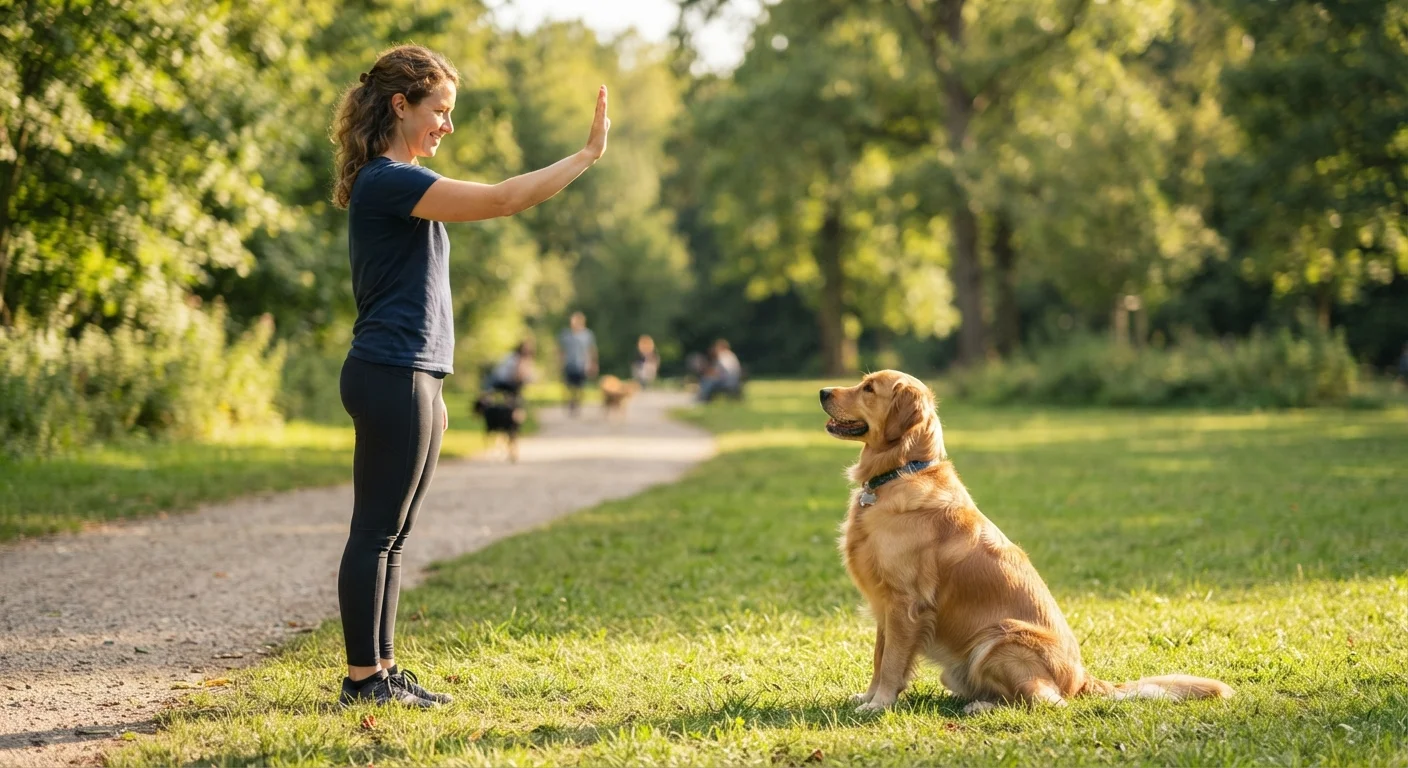
Photo: DockedReads.com | Information Made Easy editorial
Key Takeaways
- Train only one of the three Ds — duration, distance, distraction — at a time to avoid overwhelming your dog.
- Always release your dog with a clear release word before moving on; the stay ends only when you say so.
- Short, successful sessions of 5–10 minutes build a stronger stay than long, frustrating ones.
- Return to easier criteria any time your dog breaks the stay — regression is a normal part of learning.
- A reliable stay depends on consistent reinforcement across many different environments, not just at home.
Why "Stay" Is More Than One Skill
Most owners teach "stay" as a single command, then wonder why their dog holds position indoors perfectly but breaks immediately at the dog park. The reason is that a reliable stay is actually three overlapping skills: duration (how long the dog holds position), distance (how far the handler moves away), and distraction (what is happening in the environment). Behavioral science refers to these as the "three Ds," and experienced trainers treat each one as a separate training challenge before combining them.
Understanding this framework is the first step toward a stay that holds up in real life — at the vet's office, near a busy street, or when a squirrel crosses the yard. For a broader look at the concepts that underpin this kind of systematic training, see The Building Blocks of a Well-Behaved Pet.
What you will need
Tools and Setup
Keep your setup simple. You need high-value, pea-sized treats your dog is genuinely motivated by, a quiet low-distraction space to start, and a consistent marker signal — either a clicker or a short verbal marker like "yes." If you're unsure which marking method suits you and your dog, Clicker Training vs. Marker Words covers the practical differences in detail.
Choose a release word — "okay," "free," or "done" — and use it exclusively to end every stay. This word signals that your dog's job is finished; without it, the dog never knows when the stay is truly over.
High-value training treats
Reinforce correct stay behavior with a reward the dog finds highly motivating, especially in distracting environments.
Clicker or verbal marker
Precisely marks the moment your dog is doing the right thing, bridging the gap between behavior and reward.
Treat pouch or bait bag
Keeps treats accessible so reward delivery is fast and timing stays accurate.
Long line (15–20 ft leash)
Allows you to practice distance safely outdoors without risking the dog running off before the stay is reliable.
Step-by-Step: Building Duration, Distance, and Distraction
Follow the steps below in order. Resist the urge to jump ahead — layering complexity too quickly is the most common reason a stay breaks down under real-world conditions. Monitor your dog's body language throughout; tension, yawning, or repeated breaking of position can indicate stress. The article Signs Your Pet Is Stressed During Training can help you recognize when to pause or simplify.
Cue the position and mark the moment of stillness
Ask your dog to sit or lie down. The instant they settle, mark (click or say "yes") and deliver a treat without releasing them. You are reinforcing stillness, not the act of sitting. Repeat 5–8 times in a row until the dog remains calm after the marker instead of immediately jumping up.
Build duration in small increments
Begin increasing the time between the cue and the marker. Start with 2–3 seconds of stillness before marking and treating. Over several sessions, work toward 5, 10, 20, then 30 seconds. Vary the intervals unpredictably — sometimes reward at 5 seconds, sometimes at 15 — so the dog learns to wait rather than anticipate a fixed count.
End every successful repetition with your release word. Do not add distance or distraction during this phase.
Introduce distance while keeping duration short
With duration established at around 30 seconds in a stationary position, temporarily drop back to short 3–5 second stays and introduce movement. Take one step back, mark and return to reward (do not call the dog to you — come back to them), then release. Gradually increase to two steps, then three, always returning to the dog to deliver the treat.
Proof with distractions at low intensity
Once your dog holds a stay with you 10 feet away for 15–20 seconds in a quiet space, introduce mild distractions — another person walking by, a toy placed on the floor, or light background noise. Keep duration short and distance close when you first add any new distraction. Gradually increase the intensity of distractions over multiple sessions.
Generalize to new environments
Practice in at least five different locations — a different room, a front yard, a quiet parking lot, a friend's home. Each new environment is effectively a new distraction-level challenge, so expect to temporarily reduce your duration and distance when you first train somewhere unfamiliar. This is normal and not a setback.
Train One D at a Time
Combining the Three Ds and Maintaining the Skill
Once your dog consistently succeeds at each D separately — holding a 30-second stay, handling a 10-foot distance, and working amid moderate distractions — begin combining them slowly. A practical rule: when you add a new variable, reduce the others. If you're introducing a distraction, shorten the duration and close your distance temporarily.
Maintenance practice matters as much as initial teaching. Dogs who learned stay in one room often need deliberate exposure to new environments before the cue generalizes fully. Practice in different locations, at different times of day, and with different people present. For guidance on keeping sessions structured and enjoyable long-term, Keeping Training Humane, Effective, and Enjoyable offers evidence-informed principles that apply at every stage.
Keep Sessions Short and Positive
The content on this site is for informational purposes only and is not a substitute for professional advice. Always consult a qualified professional for guidance specific to your situation.