
Roundabouts, Junctions, and Intersections: A Right-of-Way Reference

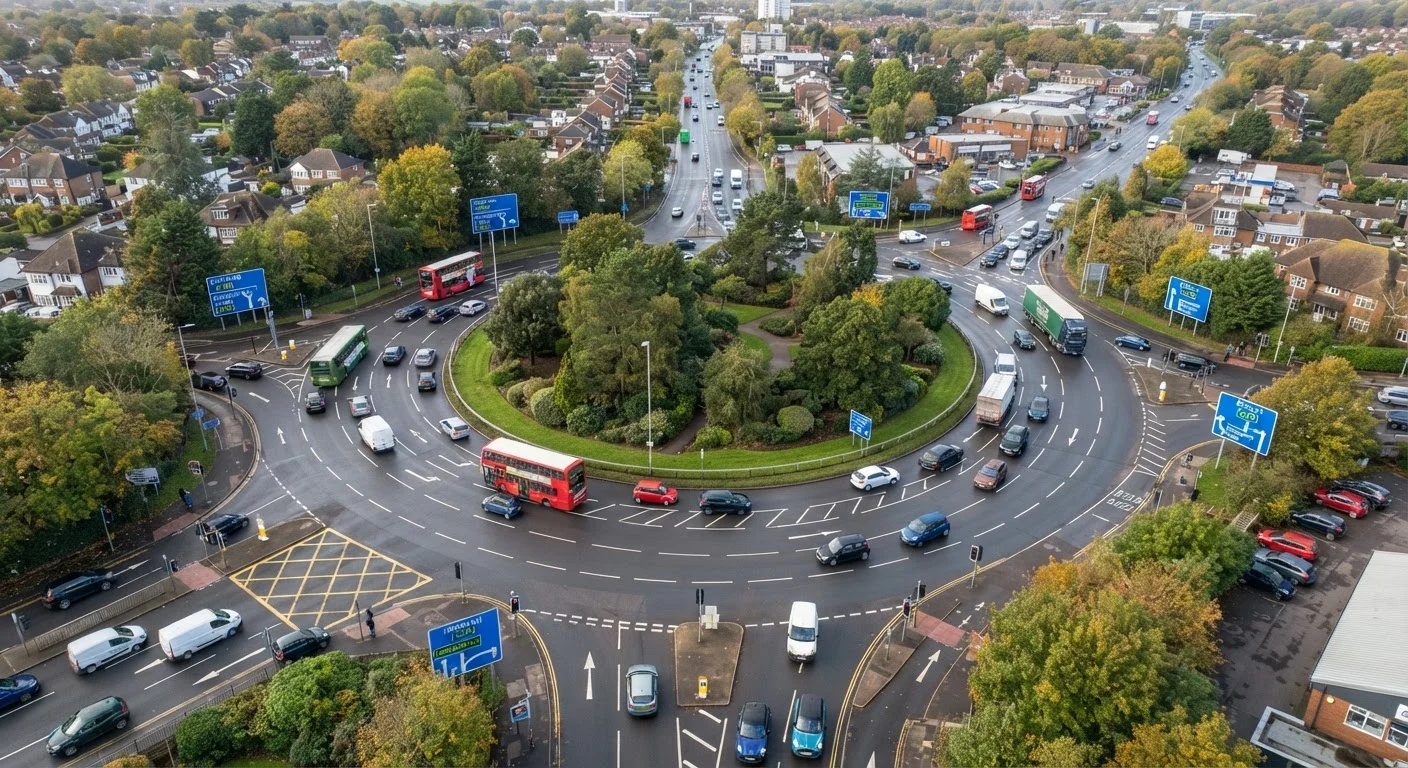
Photo: DockedReads.com | Information Made Easy editorial
Why Right-of-Way Rules Matter
Right-of-way is one of the most misunderstood concepts in everyday driving — yet getting it wrong is a leading cause of preventable collisions. It doesn't mean you have an absolute legal right to proceed; it means you are expected to yield or go based on a defined hierarchy. Knowing that hierarchy at each road type removes hesitation and reduces conflict.
This reference covers the three most common scenarios UK drivers encounter: roundabouts, T-junctions and crossroads, and traffic-light-controlled intersections. Rules here are grounded in the Highway Code, which applies across Great Britain.
Roundabouts: Give Way to the Right
The fundamental rule at all UK roundabouts is simple: give way to traffic already on the roundabout, which means traffic approaching from your immediate right. You must not enter until there is a safe gap.
Single-Lane Roundabouts
At a standard single-lane roundabout, wait at the give-way line until the circulatory carriageway is clear. Creeping forward to improve your sightline is acceptable; entering before traffic has passed is not.
Multi-Lane Roundabouts
Lane discipline becomes critical here. As a general guide: use the left lane for exits up to and including the first left or straight ahead; use the right lane for exits past straight ahead (roughly 12 o'clock). Always check road markings, as local layouts vary. Signal left as you pass the exit before your intended one.
Mini-Roundabouts
The same give-way-to-the-right rule applies, but because the central island is painted rather than raised, drivers may legally drive over it if necessary. Do not assume other drivers will yield — treat every approach with caution.
For more on adapting your approach by road environment, see how urban and motorway habits differ.
Give way
An instruction to slow down or stop and allow other vehicles or pedestrians to pass before you proceed. Indicated by a broken white line and triangular road markings.
Circulatory carriageway
The road that forms the circular loop within a roundabout, around which all traffic travels in the same direction (clockwise in the UK).
Right-of-way
The practical entitlement of one road user to proceed ahead of another in a given situation. In the UK it is defined by the Highway Code rather than absolute legal right.
Box junction
A road marking of yellow criss-cross lines that prohibits stopping within the marked area, designed to prevent gridlock at busy junctions.
Filter arrow
A green arrow signal at a traffic-light-controlled junction that permits movement in a specific direction, even when the main signal is red.
Unmarked crossroads
An intersection where two roads of roughly equal status meet without give-way lines, signals, or road markings assigning priority to either road.
Junctions: T-Junctions and Crossroads
At a T-junction, traffic on the major (through) road has priority. The driver on the minor road — the stem of the T — must give way before turning left or right onto the main road. A broken white line and a give-way sign or triangle on the road surface confirm this.
Unmarked Crossroads
Where two roads of equal width meet without any markings or signals, no driver has automatic priority. The Highway Code recommends treating these with particular care: slow down, be prepared to give way, and make eye contact where possible. Turning right here requires special attention — a driver turning right must yield to oncoming traffic travelling straight ahead.
Box Junctions
Yellow box junctions (the criss-cross yellow lines) prohibit stopping within the box unless your exit road is clear. The one exception: you may enter the box while waiting to turn right, provided your exit road is clear and you are only waiting for oncoming vehicles or pedestrians to pass.
Unmarked Junctions: No Driver Has Automatic Priority
Traffic Lights and Controlled Intersections
At signal-controlled intersections, the lights define right-of-way — but they do not override the obligation to yield to pedestrians already crossing when you are turning. Even on a green light, a driver turning left must give way to pedestrians who have stepped into the crossing on the road they are entering.
Filter Arrows
A green filter arrow permits movement in that direction only, and takes precedence over a red main signal. However, you must still check for cyclists or pedestrians crossing your path before proceeding.
Pelican, Puffin, and Toucan Crossings
These pedestrian- and cyclist-controlled crossings are positioned at or near junctions. A flashing amber phase at a pelican crossing means give way to pedestrians still crossing — you may proceed only when the crossing is clear. Puffin crossings do not have a flashing amber phase; the signal sequence is managed by sensors.
Good spatial awareness at junctions also depends on maintaining safe following distances approaching them — see the two-second rule and following distance fundamentals for how to calibrate your approach speed. Similarly, if a junction involves a lane change or merge, understanding how lane changes work provides useful context.
~24%
Fatal crashes occurring at junctions
UK Department for Transport reported that approximately a quarter of fatal road collisions involve a junction, underscoring the importance of right-of-way awareness.
Rule 185
Highway Code rule governing roundabout entry
This is the single most referenced rule for roundabout behaviour and forms the basis of the UK driving test assessment criteria.
This article provides general driving guidance based on the Highway Code for Great Britain. Always consult official government sources and current legislation for the most up-to-date rules, and seek professional instruction if you are unsure about any driving situation.
The content on this site is for informational purposes only and is not a substitute for professional advice. Always consult a qualified professional for guidance specific to your situation.