
Motion Sickness Across Different Types of Travel

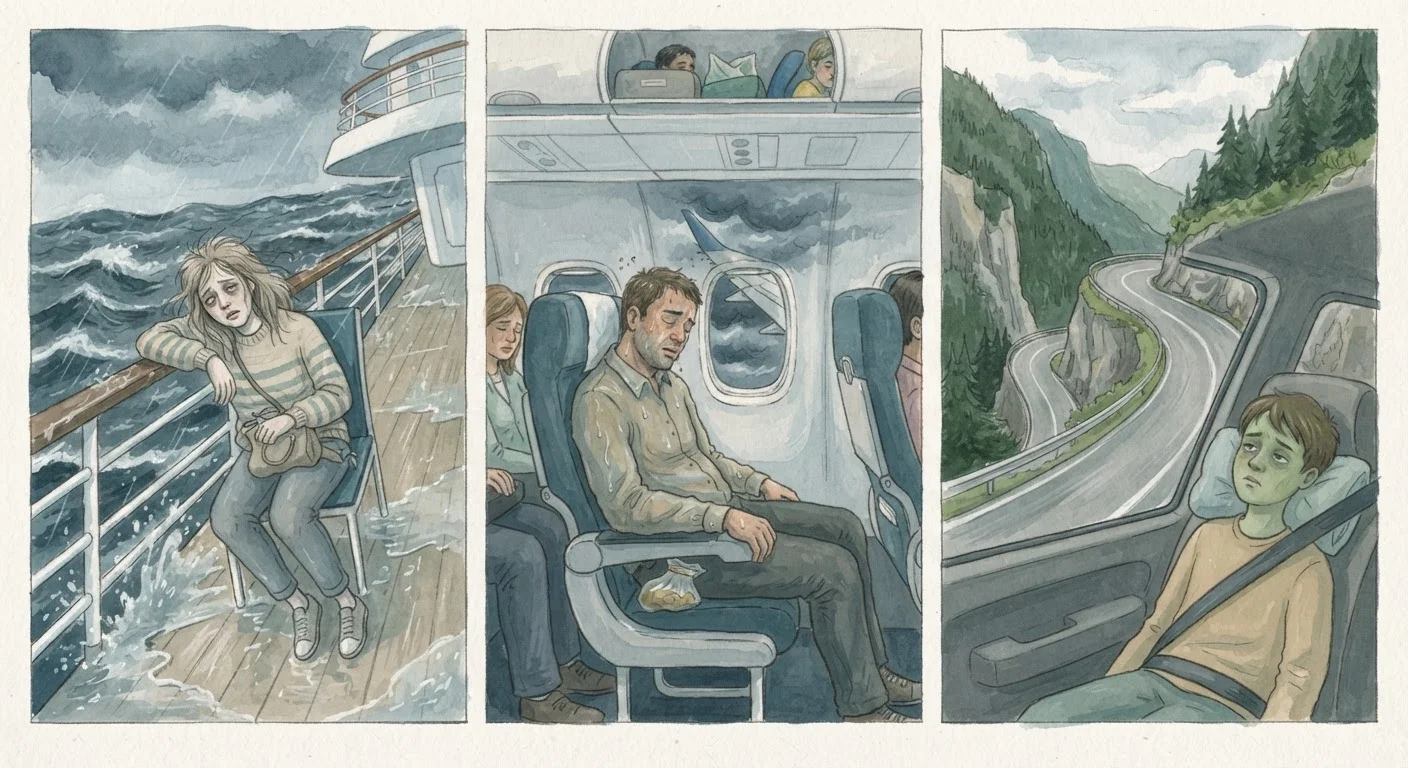
Photo: DockedReads.com | Information Made Easy editorial
Key Takeaways
- Motion sickness stems from a conflict between what your eyes see and what your inner ear senses.
- Triggers and intensity vary significantly between car travel, flying, and sea voyages.
- Positioning yourself strategically — front seat, over the wing, or midship — can meaningfully reduce symptoms.
- General coping strategies overlap across travel types, but each mode has unique considerations.
- Anyone with chronic or severe symptoms should consult a healthcare professional before traveling.
Why Motion Sickness Happens at All
At its core, motion sickness is a sensory disagreement. Your inner ear — which governs balance and spatial orientation — sends your brain one set of signals, while your eyes deliver another. On a curving highway, your body feels every turn, but your eyes might be fixed on a book. On a ship, your vestibular system registers a constant roll that your visual field doesn't always confirm. That mismatch triggers the brain's nausea response, almost like a built-in alarm for perceived poisoning or disorientation.
Most people have some susceptibility to this, though the threshold varies widely. Children between roughly ages 2 and 12 tend to be more vulnerable, while many adults find their sensitivity shifts over time. Understanding which type of travel unsettles you most is the first step toward managing it effectively. As we explore in our guide on what long-haul flights do to your body, the physical demands of travel extend well beyond motion sickness alone.
The Horizon Is Your Anchor
Car Travel: The Winding Road Problem
Car sickness is perhaps the most familiar form of motion sickness for American travelers, largely because road trips involve constant acceleration, deceleration, and turning — all while passengers are often looking sideways or downward. The front passenger seat tends to produce fewer symptoms than the back, because the forward view better aligns what the eyes see with what the body feels. Children in rear-facing seats face an especially pronounced mismatch.
Looking out toward the horizon, keeping the window slightly open, and avoiding screens or reading material during motion are widely recommended general strategies. Some people find that eating a light meal beforehand helps, while others prefer an empty stomach — individual responses genuinely vary. Frequent stops on long drives give the body a chance to recalibrate. If someone in your group struggles consistently, it's worth factoring that into trip planning from the outset rather than treating it as an afterthought.
| Car Travel | Air Travel | Sea Travel | |
|---|---|---|---|
| Primary trigger | Turning, acceleration, downward gaze | Turbulence, lack of visual reference | Continuous low-frequency rolling |
| Best position | Front seat, facing forward | Over-wing, window seat | Midship, lower deck cabin |
| Duration of exposure | Hours, with frequent stops possible | Hours, largely confined to seat | Days of continuous motion |
| Adaptation likelihood | Limited — stops help reset | Moderate — turbulence is episodic | High — sea legs often develop |
| Key general strategy | Fix gaze on horizon, open window | Stay hydrated, breathe steadily | Fresh air, stay midship, rest |
Air Travel: Turbulence and the Pressurized Cabin
Flying introduces a distinct set of triggers. Turbulence creates sudden vertical and lateral jolts that the inner ear registers acutely, especially when the passenger can't see outside. Seats over the wing sit closest to the aircraft's center of lift and generally experience less pronounced movement than those at the nose or tail. A window seat — where you can fix your gaze on the horizon or the stationary wing — tends to be easier than a middle or aisle seat for motion-sensitive flyers.
The pressurized cabin environment adds another layer of complexity. Dehydration and lower oxygen levels at altitude can amplify feelings of nausea and fatigue for some people. Staying well-hydrated, avoiding alcohol, and choosing bland food before and during flight are sensible general precautions. Slow, deliberate breathing during turbulence can also help interrupt the anxiety-nausea feedback loop — a connection explored more fully in our piece on travel anxiety and its many triggers.
Sea Travel: The Persistent Roll
Cruise ships and ferries present a uniquely sustained motion challenge. Unlike car or air travel — where motion is episodic — sea travel often involves continuous low-frequency movement that the body must adapt to over hours or days. Many passengers find that symptoms ease after 24 to 48 hours as the brain recalibrates, a phenomenon sometimes called sea legs. Others do not adapt as readily.
Cabin placement matters significantly aboard a ship. Midship staterooms on lower decks experience less movement than cabins at the bow or stern, or on higher decks where the vessel's roll is more amplified. Spending time on deck in fresh air, keeping eyes on the horizon, and staying hydrated are commonly suggested general approaches. Acupressure wristbands, which apply pressure to the P6 point on the inner wrist, have mixed evidence behind them but are considered low-risk to try. Anyone with known severe susceptibility should speak with a healthcare provider well before departure — managing health conditions while traveling covers how to approach that kind of pre-trip medical planning.
~33%
Adults susceptible to motion sickness
Estimates from vestibular research suggest roughly one in three adults experiences motion sickness under sufficiently provocative conditions.
24–48 hrs
Typical sea-legs adaptation window
Many passengers report noticeable reduction in ship-related nausea within the first one to two days of a voyage as the brain adjusts.
This article is for general informational purposes only and does not constitute medical advice. Consult a qualified healthcare professional for guidance specific to your health needs.
The content on this site is for informational purposes only and is not a substitute for professional advice. Always consult a qualified professional for guidance specific to your situation.