
The Distinct Rhythms of Buenos Aires, Lima, and Mexico City

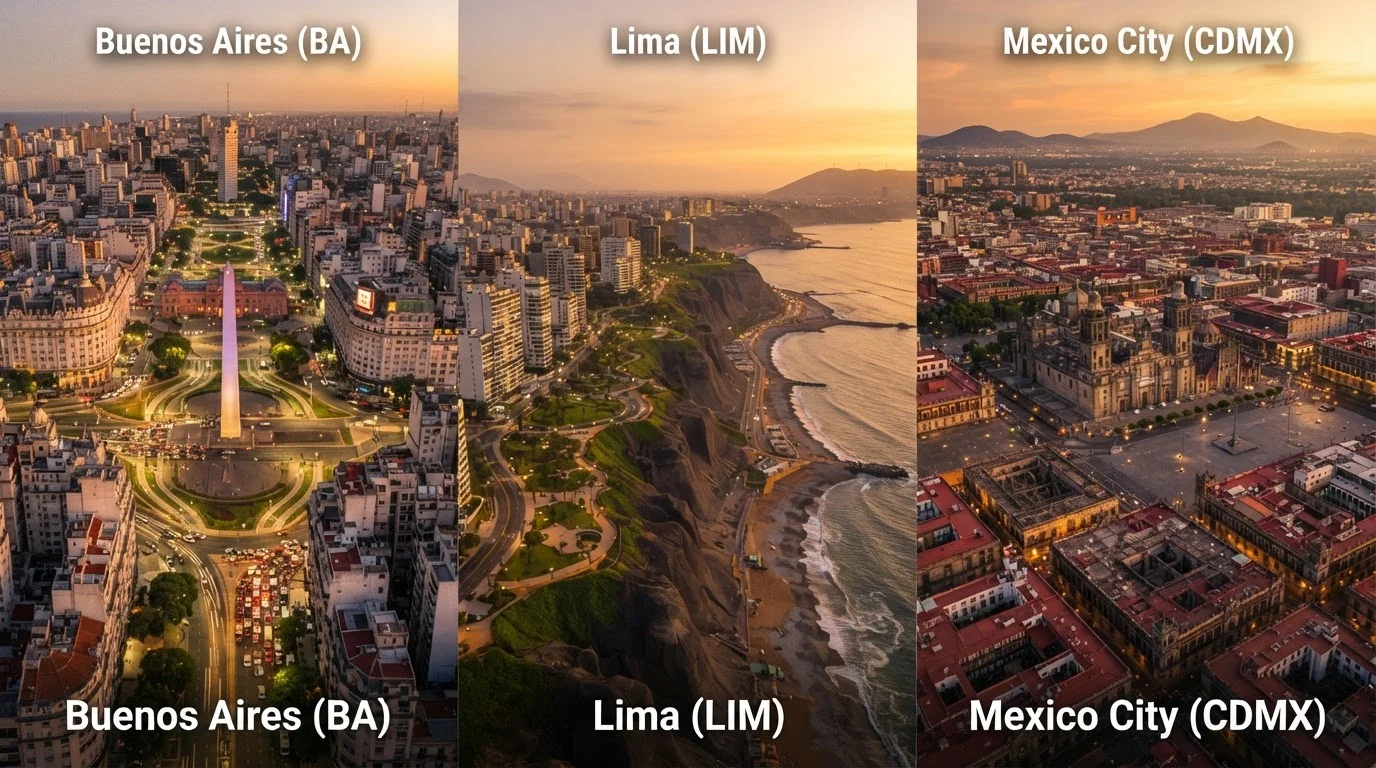
Photo: DockedReads.com | Information Made Easy editorial
Key Takeaways
- Buenos Aires rewards slow, immersive travel with its European cadence and deeply social street culture.
- Lima has emerged as one of the world's most exciting culinary destinations, anchored by centuries of coastal and Andean tradition.
- Mexico City offers unmatched historical depth, a thriving arts scene, and remarkable neighbourhood diversity.
- Each city carries distinct safety, altitude, and logistics considerations that travellers should research before booking.
- All three cities are best explored on foot and by local transit — car-dependent itineraries miss what makes them tick.
Three Cities, Three Different Promises
Ask seasoned travellers which Latin American capital left the deepest impression and you will rarely get the same answer twice. Buenos Aires, Lima, and Mexico City each occupy a singular position — not only on the map but in the imagination of anyone who has spent real time inside them. They are all enormous, historically layered, and emotionally generous toward curious visitors. Yet they operate on completely different frequencies.
This is not a ranking. It is an attempt to render each city honestly, so that the traveller sitting with an open calendar can make a decision grounded in something more useful than a highlight reel. If you have ever wondered how to decode an unfamiliar city before you arrive, the approach described in reading a new city without a tour guide applies powerfully to all three of these destinations — each rewards pre-trip neighbourhood research enormously.
Buenos Aires: The City That Keeps Late Hours
Buenos Aires carries the cadence of a place that genuinely believes dinner before 9 p.m. is a rushed affair. The Argentine capital is famously European in its bones — wide Haussmann-inspired boulevards, ornate Belle Époque facades, a café culture that treats lingering as a civic virtue — but it is unmistakably South American in its emotional intensity. Porteños (as residents call themselves) talk with their hands, debate politics at volume, and grieve and celebrate with equal theatrical commitment.
The city's neighbourhoods are its real architecture. Palermo Soho and Palermo Hollywood offer creative density — independent bookshops, design studios, wine bars. San Telmo carries the weight of the colonial era with its cobblestones and Sunday antique markets. Recoleta presents grand cemetery avenues and tree-lined residential streets that feel transplanted from Paris. Each barrio has its own register.
Travellers should be aware that Argentina's economy has experienced prolonged volatility. Currency exchange conditions and day-to-day costs can shift significantly, so verifying current practical information through your government's travel advisory and current traveller forums is essential before departure. The city is generally walkable and has an extensive subway system, though visitors should take standard urban precautions.
Make Time for the Neighbourhood, Not Just the Landmark
Lima: Where the Pacific Shapes Everything
Lima sits on coastal desert cliffs above the Pacific — a geography that feels almost counterintuitive until you understand that the cold Humboldt Current running up from Antarctica keeps the city shrouded in a grey marine layer for much of the year. This garúa, as the mist is called locally, is part of Lima's character: moody, atmospheric, quietly dramatic.
What has drawn international attention to Lima in recent decades is its food culture, widely considered among the most complex and exciting anywhere in the world. The city's cuisine is the product of centuries of Indigenous, Spanish, African, Japanese, and Chinese influences layering over one another — resulting in dishes like ceviche, lomo saltado, and causa that bear the fingerprints of multiple continents. Exploring Lima's mercados (public markets) and neighbourhood cevicherías is, for many visitors, the primary reason to come.
Beyond food, Lima's historic centre (Centro Histórico) is a UNESCO World Heritage Site, housing baroque churches and colonial plazas that speak to the city's role as the seat of Spanish colonial power in South America. The Larco Museum, housed in an 18th-century mansion, holds one of the most significant pre-Columbian collections in the world. Miraflores and Barranco — coastal districts with clifftop parks and a thriving arts scene — offer a contrasting, more relaxed urban register.
| Buenos Aires | Lima | Mexico City | |
|---|---|---|---|
| Altitude | Sea level | Near sea level | ~7,350 ft (2,240 m) |
| Primary draw | Culture, nightlife, street life | Cuisine, colonial history | History, museums, neighbourhoods |
| Best season to visit | Oct–Dec, Mar–Apr (spring/autumn) | Dec–Apr (summer, less fog) | Oct–Apr (dry season) |
| Walkability | Very high in central barrios | High in Miraflores/Barranco | High in historic centre and Roma |
| Language immersion ease | Spanish (Argentine accent) | Spanish (Peruvian accent) | Spanish (Mexican accent) |
| Typical trip length | 4–7 days minimum | 3–5 days | 5–7 days |
Mexico City: Depth, Density, and Contradiction
Mexico City operates at a scale that can feel overwhelming on arrival and revelatory within days. Built on the drained lakebed of the ancient Aztec capital Tenochtitlán, the city carries its pre-Columbian history not as a museum exhibit but as a living substrate — literally so, since the sinking of the old lake floor means many colonial-era buildings tilt at gentle, vertiginous angles.
The historic centre (Centro Histórico) alone could occupy a traveller for a week: the Metropolitan Cathedral, the ruins of the Templo Mayor, the murals of Diego Rivera at the Palacio Nacional. But Mexico City's genius is in its plurality. Roma Norte and Condesa offer tree-lined streets, mid-century architecture, and a neighbourhood coffee culture that would be at home in any cosmopolitan capital. Coyoacán retains a village-within-the-city character, quieter and residential, anchored by the Frida Kahlo Museum. Xochimilco's ancient canal system offers a completely different relationship with water and collective festivity.
Sitting at roughly 7,350 feet (2,240 metres) above sea level, Mexico City presents a real altitude consideration for visitors arriving from coastal cities or from the United States. Most people acclimate within a couple of days, but it is wise to take the first 24 to 48 hours gently, stay well hydrated, and avoid strenuous activity immediately upon arrival. Anyone with cardiovascular or respiratory conditions should consult a healthcare professional before travelling to high-altitude destinations.
Altitude Adjustment in Mexico City
For travellers who find that wilderness calls as strongly as the city, it is worth noting that Patagonia — explored in detail in the comprehensive picture of visiting Patagonia — represents the dramatic counterweight to Latin America's urban energy: remote, demanding, and unforgettable in an entirely different register.
~9 million
Greater Buenos Aires metro population
Buenos Aires is one of South America's largest urban agglomerations, according to UN demographic estimates.
Top 50
Lima restaurants on World's 50 Best list
Lima has consistently placed multiple restaurants on the World's 50 Best Restaurants list, reflecting its global culinary standing.
21+ million
People in Greater Mexico City
Mexico City's metropolitan area is one of the largest in the Western Hemisphere by population, per INEGI data.
The content on this site is for informational purposes only and is not a substitute for professional advice. Always consult a qualified professional for guidance specific to your situation.