
Index Funds vs Actively Managed Funds

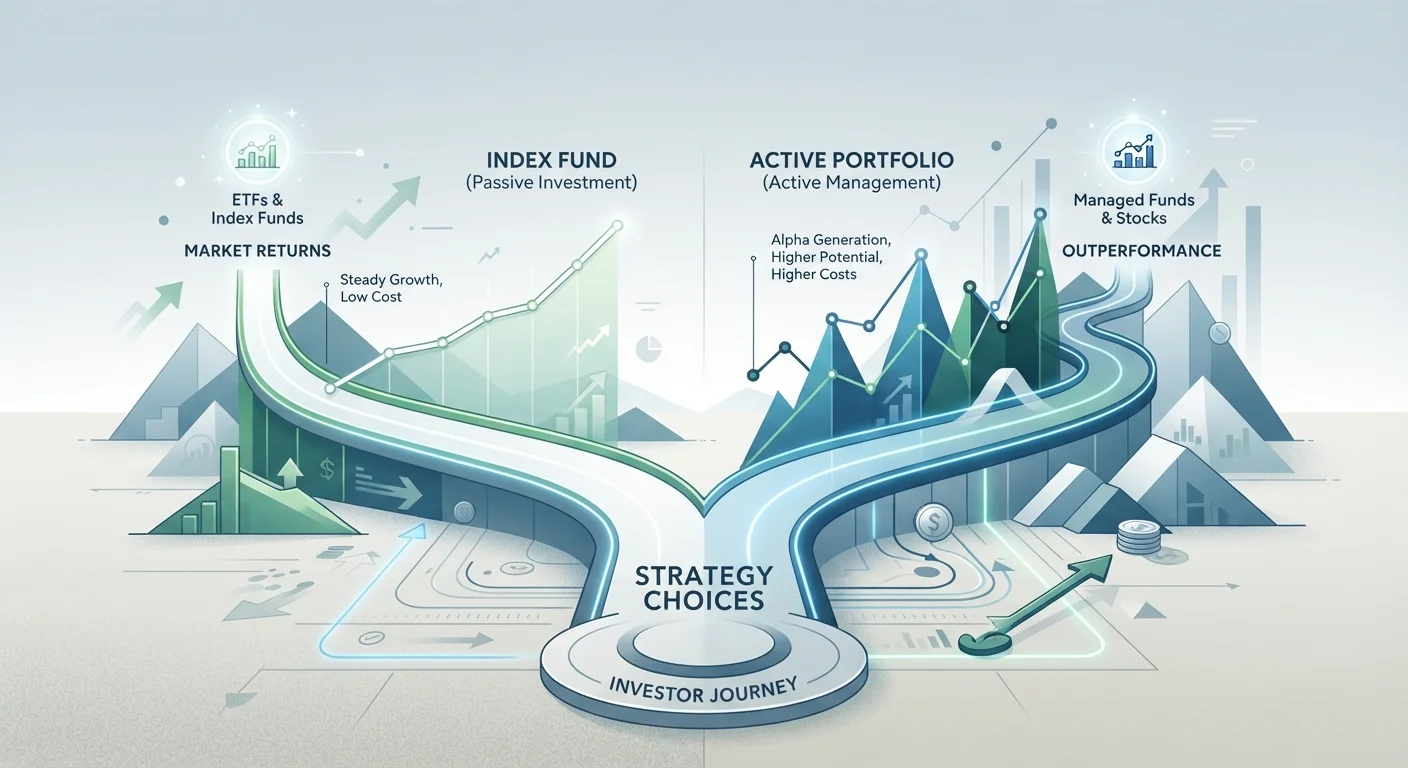
Photo: DockedReads.com | Information Made Easy editorial
Key Takeaways
- Index funds passively track a market benchmark; actively managed funds rely on a portfolio manager's decisions.
- Index funds typically carry significantly lower annual fees than actively managed funds.
- Research consistently shows most actively managed funds underperform their benchmark index over the long term.
- Neither approach eliminates investment risk — both can lose value during market downturns.
- Your time horizon, fee tolerance, and investment goals should guide which approach fits your situation.
- Consulting a licensed financial adviser is the best way to evaluate options for your personal circumstances.
How Each Approach Works
Understanding the mechanics behind each fund type is essential before comparing them. To learn what happens to your money once you invest it, see what actually happens to your money when you invest.
An index fund is a pooled investment vehicle designed to replicate the performance of a specific market index — for example, the S&P 500 or the total U.S. bond market. Because the fund simply mirrors an existing index, no manager is actively selecting securities. Holdings change only when the index itself changes. This passive approach keeps trading activity — and therefore costs — very low.
An actively managed fund employs a portfolio manager (or team) who researches securities, makes buy and sell decisions, and attempts to outperform a stated benchmark. The manager's judgment drives every holding. This requires more research infrastructure, trading activity, and specialist labor — all of which are reflected in higher fees charged to investors.
Both structures can hold stocks, bonds, or a mix. For a primer on these building blocks, see stocks, bonds, and funds explained.
| Criterion | Index Funds | Actively Managed Funds |
|---|---|---|
| Management style | Passive — tracks an index | Active — manager selects holdings |
| Typical annual expense ratio | Under 0.20% | 0.50%–1.50%+ |
| Trading frequency | Low — only when index changes | Higher — driven by strategy |
| Benchmark goal | Match the benchmark | Beat the benchmark |
| Long-term outperformance record | Matches market by design | Majority underperform net of fees |
| Transparency of holdings | High — mirrors public index | Varies — disclosed periodically |
| Investor effort required | Minimal — no manager monitoring needed | Higher — manager track record matters |
The Cost Gap and Why It Matters
Fees compound alongside returns — meaning a persistent cost difference has an outsized effect over decades. Index funds typically carry expense ratios well below 0.20% annually. Many broad-market index funds charge even less. Actively managed funds commonly charge between 0.50% and 1.50% or more per year.
~0.05%
Typical index fund expense ratio
Many broad-market U.S. index funds charge annual expense ratios as low as 0.03%–0.10%, according to industry data from Morningstar.
~85%
Active U.S. equity funds underperforming over 15 years
S&P Dow Jones Indices' SPIVA data has consistently shown that roughly 80–90% of actively managed U.S. large-cap equity funds trail the S&P 500 over 15-year periods, after fees.
1%+
Average annual fee gap between fund types
The difference in annual costs between a typical actively managed equity fund and a comparable index fund has historically exceeded one percentage point, per Morningstar research.
A seemingly small annual difference of 1% in fees can translate to a meaningful reduction in ending portfolio value over a 20- or 30-year investment horizon, due to the compounding effect. This does not mean active funds can never justify their fees — but it does mean they need to outperform by at least the fee difference just to break even on a net-return basis.
This article is for general informational and educational purposes only and does not constitute personalised financial or investment advice. Past performance does not guarantee future results. Consult a qualified financial adviser before making investment decisions.
What the Performance Evidence Shows
The question of whether active managers consistently beat their benchmarks has been studied extensively. The S&P Indices Versus Active (SPIVA) scorecards — published regularly by S&P Dow Jones Indices — have tracked this over rolling periods. Their data historically shows that the majority of actively managed U.S. equity funds underperform their benchmark index over 10- and 15-year periods, after fees.
Past Performance Is Not a Guarantee
That said, performance varies by fund category and market segment. In markets considered less informationally efficient — certain international or small-cap segments — the evidence on active management is less one-sided, though still mixed. And crucially, identifying in advance which active managers will outperform is itself a challenging task with no reliable method.
For readers exploring common misconceptions about beating the market, investing myths that keep ordinary people on the sidelines examines the evidence directly.
Making a Decision That Fits Your Goals
No single fund type is universally superior for every investor. The right choice depends on your investment time horizon, how much you want to pay in fees, your tolerance for variability in outcomes, and whether you believe a particular manager or strategy can add value above costs.
Many long-term investors use index funds as a core holding precisely because their low cost, broad diversification, and predictable tracking behaviour align well with a patient, buy-and-hold approach. Others allocate a smaller portion to actively managed strategies in specific categories where they believe a case exists for active selection.
How you put money to work — all at once or gradually — is a separate but related question covered in lump-sum investing vs drip-feeding money in over time. And if you're weighing investing against simply saving in cash, investing for a long-term goal vs saving in cash walks through the key trade-offs.
Whatever direction you lean, a licensed financial adviser can help you assess whether a specific fund aligns with your personal financial picture — including tax situation, risk tolerance, and goals.
The content on this site is for informational purposes only and is not a substitute for professional advice. Always consult a qualified professional for guidance specific to your situation.