
Lump-Sum Investing vs Drip-Feeding Money In Over Time

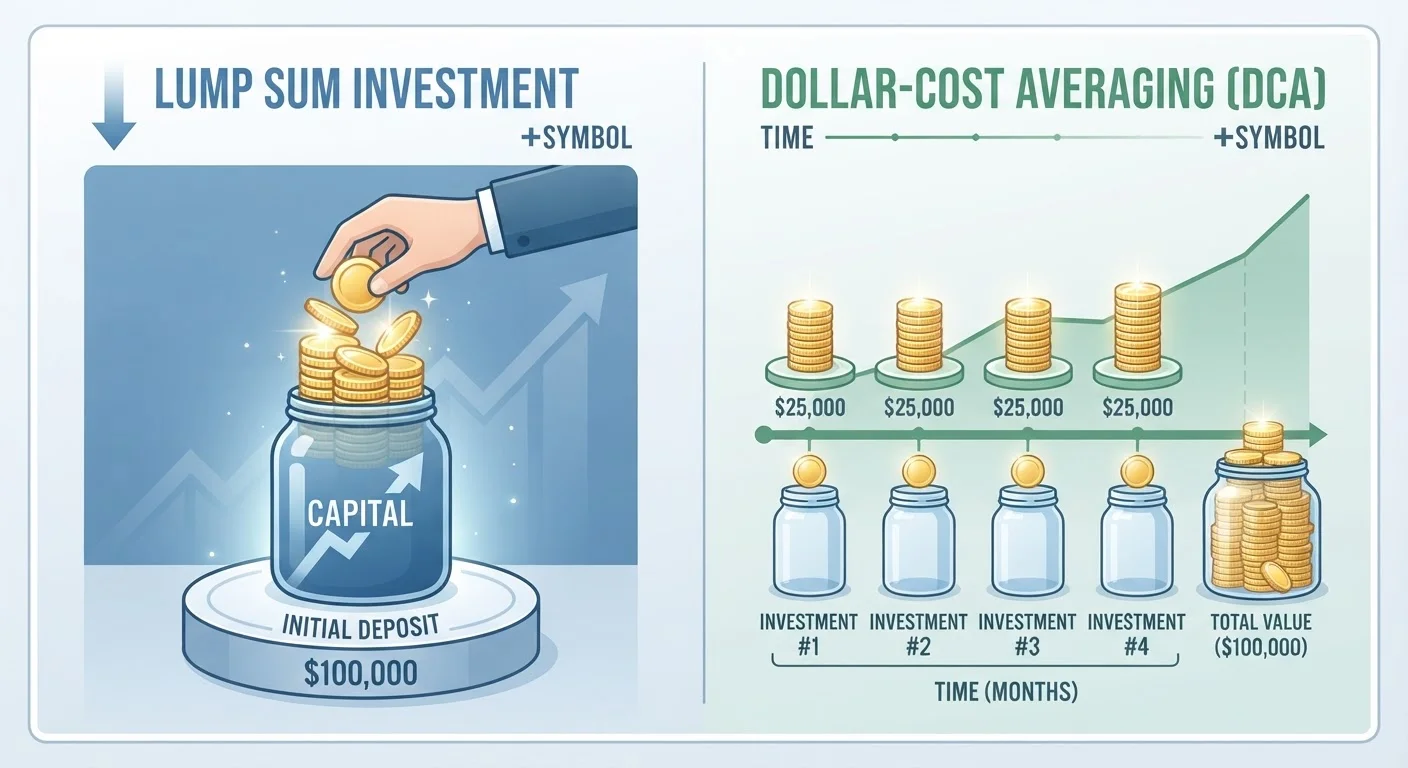
Photo: DockedReads.com | Information Made Easy editorial
Key Takeaways
- Lump-sum investing historically outperforms gradual investing about two-thirds of the time, according to Vanguard research.
- Dollar-cost averaging (drip-feeding) reduces the emotional risk of investing at a market peak.
- Neither strategy eliminates investment risk — both expose your money to market volatility.
- Your available capital, timeline, and emotional temperament all influence which approach suits you.
- Consult a qualified financial adviser before making decisions tailored to your personal situation.
What the Two Strategies Actually Mean
Lump-sum investing means deploying a single, full amount into the market at one point in time — for example, investing an inheritance or a large savings balance all at once. Dollar-cost averaging (DCA), sometimes called drip-feeding, means dividing that same capital into equal instalments and investing them at regular intervals — weekly, monthly, or quarterly — regardless of what the market is doing.
Both strategies aim at the same destination: growing wealth over time. They simply differ in how quickly your money begins working. As compound interest rewards patience, the timing of deployment matters more than many investors realise.
It's worth noting that for most people who invest regularly from a salary, DCA is already their default — every paycheck-funded pension contribution is, in effect, a form of drip-feeding.
What Research Suggests About Each Approach
A widely cited Vanguard study analysed historical US, UK, and Australian market data and found that lump-sum investing outperformed a 12-month DCA schedule roughly two-thirds of the time, with the average outperformance in the range of a few percentage points. The intuition is straightforward: markets trend upward over long periods, so money invested sooner has more time to benefit from that trend.
~68%
Share of periods lump-sum beat DCA
Vanguard research across US, UK, and Australian markets found lump-sum investing outperformed a 12-month DCA schedule roughly two-thirds of the time.
Time > Timing
Core principle behind lump-sum advantage
Because equity markets have historically trended upward over long periods, money invested sooner tends to compound more — rewarding early deployment.
However, the same research acknowledged that DCA still produced positive returns in the vast majority of scenarios — it simply lagged behind lump-sum in many cases. Crucially, in periods where markets fell significantly after the lump-sum deployment, DCA investors fared better by having avoided putting everything in at a peak.
Past performance, of course, does not guarantee future results. No strategy removes the fundamental uncertainty of investing. To understand how this fits with broader misconceptions, see our piece on common investing myths.
The Psychological Dimension
Numbers don't capture everything. One of DCA's most underappreciated strengths is behavioural: it lowers the emotional stakes of any single decision. An investor who puts everything in at once and then watches the market fall 20% may panic and sell — locking in losses and undermining the strategy entirely. The investor who drip-feeds can tell themselves that next month's instalment will buy units at a lower price, which is genuinely true.
A Middle Path Worth Considering
This matters because investment outcomes depend as much on investor behaviour as on the underlying strategy. Consistent investing habits — staying the course through volatility, avoiding impulsive exits — are what separate long-term success from short-term frustration. If lump-sum investing would keep you up at night, the marginal statistical edge may not be worth the psychological cost.
Key Trade-Offs at a Glance
| Lump-Sum Investing | Dollar-Cost Averaging | |
|---|---|---|
| Historical return potential | Higher on average over long periods | Slightly lower on average, but still positive |
| Time in the market | Maximum from day one | Builds gradually over the period |
| Emotional difficulty | Higher — one high-stakes decision | Lower — risk spread across multiple decisions |
| Downside if market falls after investing | Full capital exposed immediately | Remaining instalments buy at lower prices |
| Suitability for regular income investors | Less practical without a large existing sum | Natural fit for monthly salary-based investing |
| Complexity | Simple — one transaction | Requires ongoing discipline and scheduling |
Both approaches benefit from being housed in tax-efficient structures. How you invest matters as well as when — see our overview of tax-advantaged account wrappers for context on how account type affects long-term outcomes. Whichever strategy you use, diversification across asset types remains essential to managing risk.
This article is for general informational and educational purposes only. It does not constitute personalised financial or investment advice. Please consult a qualified, licensed financial adviser before making decisions about your own investments.
The content on this site is for informational purposes only and is not a substitute for professional advice. Always consult a qualified professional for guidance specific to your situation.