
Financing a Car Through a Dealer vs. a Bank or Credit Union

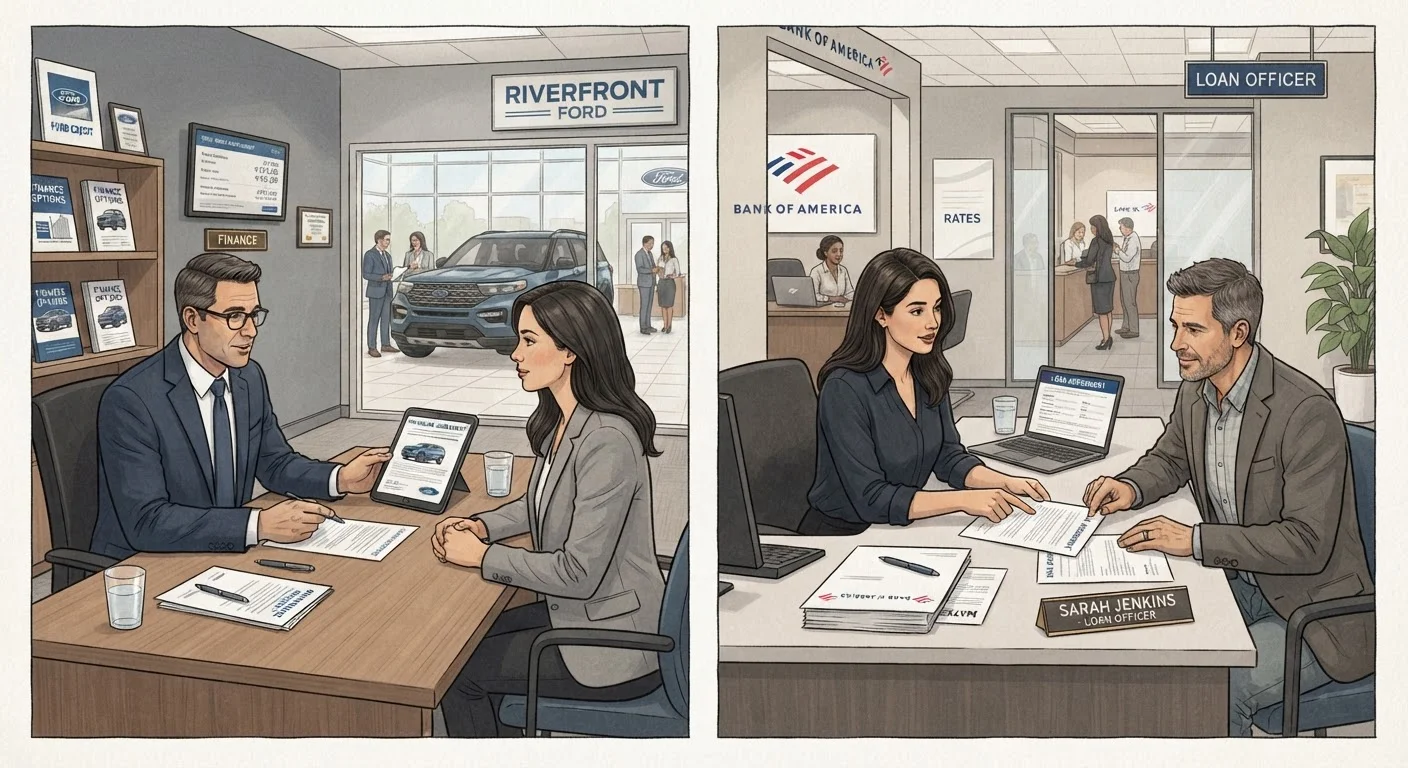
Photo: DockedReads.com | Information Made Easy editorial
Key Takeaways
- Dealer financing and direct lending both fund the same loan, but differ in rate transparency and negotiating dynamics.
- Dealers may mark up interest rates above what a lender originally quotes, a practice called dealer reserve.
- Pre-approval from a bank or credit union gives you a benchmark rate before entering dealership negotiations.
- Neither channel is universally superior — the better option depends on your credit profile, loan terms, and the specific offers available.
- Auto loan terms are general financial education; consult a qualified financial professional for advice tailored to your situation.
How Each Financing Channel Works
When you finance a vehicle, the loan itself is always issued by a financial institution — a bank, credit union, or captive lender affiliated with an automaker. The difference between dealer financing and direct lending is about who arranges that loan and at what terms.
Dealer-arranged financing works through the dealership's finance and insurance (F&I) office. The dealer submits your application to one or more lenders in its network, secures a wholesale rate, and then presents you with an offer — often at a slightly higher rate. The spread between the wholesale rate and what you're quoted is sometimes called dealer reserve, and it represents additional profit for the dealership.
Direct lending means you obtain a loan offer — or a pre-approval — directly from a bank or credit union before visiting the dealership. You arrive knowing your approved rate and maximum loan amount, effectively treating the dealer's financing desk as one option among several. Credit unions, in particular, are often noted for competitive rates because they operate as member-owned nonprofits. Understanding terms like APR and amortization is essential; see the everyday savings and debt glossary for clear definitions.
Comparing the Two Approaches
The table below summarizes how dealer financing and direct lending compare across the criteria most relevant to a typical US car buyer.
| Dealer Financing | Bank or Credit Union | |
|---|---|---|
| Convenience | One-stop shop at the dealership | Requires separate application process |
| Rate transparency | Rate may include dealer markup | Rate quoted is rate you pay |
| Promotional offers | Access to manufacturer-subsidized rates | Standard market rates only |
| Negotiating position | Buyer has less direct leverage | Pre-approval creates clear benchmark |
| Credit union membership required | No | Yes, for credit unions |
| Speed of approval | Often same day at dealership | May take 1–3 business days |
| Lender options | Multiple lenders via dealer network | Single institution per application |
One dynamic worth noting: dealer financing consolidates the car-buying and financing steps into a single visit, which many buyers find convenient. However, that convenience can come at a cost if the rate markup goes unexamined. Common car ownership myths — including the assumption that dealers always offer the best financing — can quietly cost buyers money over a multi-year loan term.
Rate Transparency and the Markup Question
A key structural difference is rate transparency. With direct lending, the rate you're quoted is the rate you pay — there is no intermediary adding a margin. With dealer financing, the final rate you see may be higher than what the lender originally approved, because dealers are typically permitted to mark up the buy rate within limits set by the lender.
Watch for Rate Markup in Dealer Quotes
This doesn't mean dealer financing is always more expensive. Captive lenders — the financing arms of automakers — sometimes offer promotional rates, including low or zero-percent APR offers on select models for qualified buyers. These promotions can be genuinely advantageous, but they typically require strong credit and may be structured to offset other incentives like cash-back rebates. Understanding how fixed-rate vs. variable-rate debt works can help you evaluate whether a quoted promotional term is truly favorable over the loan's full duration.
Using Pre-Approval as a Negotiating Tool
Financial educators and consumer advocates broadly agree on one strategic principle: obtaining a pre-approval from a bank or credit union before shopping creates useful leverage. With a concrete rate offer in hand, you can compare it directly against whatever the dealer's F&I office presents — rather than evaluating the dealer's offer in isolation.
Get Pre-Approved Before You Shop
It also separates the negotiation into cleaner parts. Keeping the vehicle price discussion distinct from the financing terms helps prevent a common dynamic where monthly payment figures are adjusted in ways that obscure the true cost of the loan. For a broader look at how debt fits into personal financial planning, the managing savings and debt guide offers durable, principle-based framing. And if you're weighing whether financing a vehicle is the right move at all, situations where carrying debt can be rational may provide useful context.
This article is for general informational and educational purposes only and does not constitute personalized financial or legal advice. Consult a qualified financial professional before making decisions about borrowing or loan products.
The content on this site is for informational purposes only and is not a substitute for professional advice. Always consult a qualified professional for guidance specific to your situation.