
Whole Foods vs. Processed Foods: What the Distinction Really Means

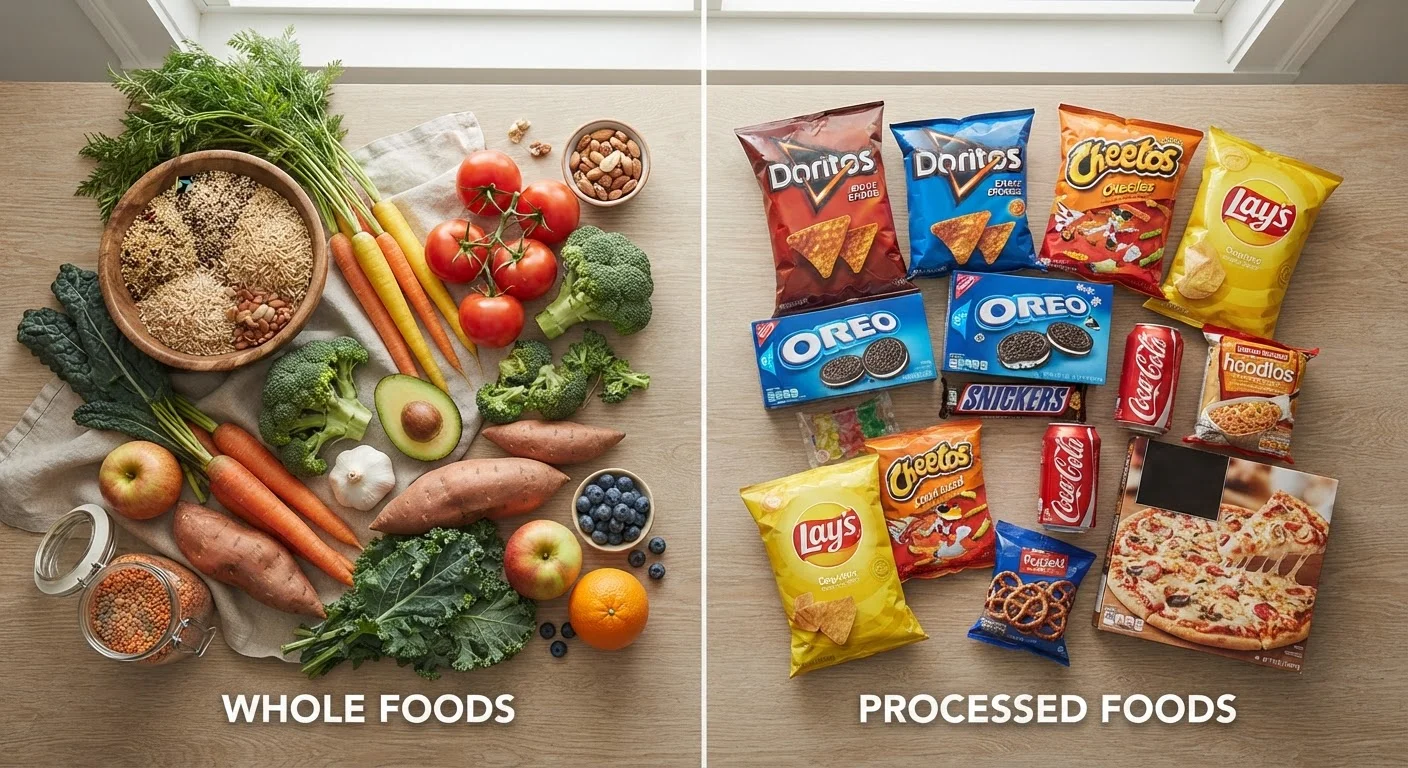
Photo: DockedReads.com | Information Made Easy editorial
Key Takeaways
- Processing exists on a spectrum; minimally processed foods can still be nutritious and practical.
- Ultra-processed foods — heavily engineered products — are where research raises the most consistent health concerns.
- Whole foods generally retain more fiber, vitamins, and minerals than their heavily processed counterparts.
- No single food choice defines a healthy diet; overall eating patterns matter more than individual items.
- Reading ingredient lists helps identify where a food falls on the processing spectrum.
Defining the Terms: What Makes a Food 'Whole' or 'Processed'?
The terms whole food and processed food get used constantly in nutrition conversations, but they're often poorly defined. A whole food is generally understood to be a food in its natural, unaltered — or only minimally altered — state: a raw apple, dried lentils, a plain chicken breast, or steel-cut oats. The key quality is that the food retains its original cellular structure and most of its native nutrients.
Processing, by contrast, refers to any deliberate change made to a food before it reaches the consumer. This ranges from washing and chopping to industrial-scale extraction, fractionation, and reformulation. Because the definition is so broad, nutritionists and researchers commonly use the NOVA classification system, developed by researchers at the University of São Paulo, to organize foods into four groups based on the extent and purpose of processing:
- Group 1: Unprocessed or minimally processed foods (fresh fruit, eggs, plain milk)
- Group 2: Processed culinary ingredients (olive oil, flour, salt)
- Group 3: Processed foods (canned tomatoes, cheese, cured meats)
- Group 4: Ultra-processed foods (UPFs) — industrial formulations with many additives, little or no whole food content
Understanding this spectrum matters because lumping all processed foods together — treating frozen peas the same as a packaged snack cake — obscures genuinely meaningful nutritional differences. For a broader look at why nutrition guidance can feel contradictory, see how dietary guidelines are formed.
How Nutritional Profiles Compare Across the Spectrum
Whole and minimally processed foods tend to retain their full complement of fiber, vitamins, minerals, and phytonutrients. When food undergoes extensive processing, several things can happen: heat-sensitive vitamins degrade, fiber is removed or reduced, and beneficial plant compounds are stripped out. Manufacturers sometimes add back select nutrients — a practice called fortification — but this doesn't fully replicate the nutrient matrix of the original food.
| Criterion | Whole Foods | Ultra-Processed Foods |
|---|---|---|
| Fiber content | Naturally high; structure intact | Often removed or significantly reduced |
| Micronutrient density | Full native vitamin and mineral profile | Degraded; sometimes partially restored via fortification |
| Added sugar and sodium | None added by definition | Frequently high; used for flavor and preservation |
| Additives and preservatives | None | May include emulsifiers, artificial flavors, colorants |
| Shelf life | Often short; perishable | Extended; engineered for stability |
| Satiety per calorie | Generally higher due to fiber and water | Often lower; designed for palatability over fullness |
| Cost and accessibility | Varies; fresh produce can be expensive | Often low-cost and widely available |
Ultra-processed foods often deliver what researchers call empty energy: calories from refined carbohydrates, saturated fats, and added sugars without proportionate micronutrient value. They are also commonly engineered for hyper-palatability — a combination of salt, fat, and sugar calibrated to encourage overconsumption. Research published in journals such as The BMJ and Cell Metabolism has found associations between high UPF consumption and elevated risk of obesity, cardiovascular disease, and type 2 diabetes, though researchers note that causality is difficult to establish definitively given the complexity of dietary patterns.
The sugar question is particularly nuanced. Naturally occurring sugars in whole fruit arrive packaged with fiber and water, which slows absorption. That context is fundamentally different from added sugars in ultra-processed products. For a deeper look at this distinction, see how added and naturally occurring sugars compare.
Where Processed Foods Fit Practically — and Where They Fall Short
It would be overly simplistic — and unhelpful — to declare all processed foods off-limits. Plain yogurt, canned beans, frozen spinach, and whole-grain bread are all processed to varying degrees, yet all can anchor a nutritionally sound eating pattern. The critical variable is how much processing has occurred and what has been added or removed in the process.
~57%
Share of US calories from ultra-processed foods
A National Health and Nutrition Examination Survey analysis estimated ultra-processed foods provide roughly 57% of daily energy intake for US adults.
4 groups
NOVA food classification categories
The NOVA system, developed by University of São Paulo researchers, classifies foods by degree of industrial processing rather than nutrient content alone.
10%+
Increased cardiovascular disease risk association
Several large observational studies published in The BMJ have found associations between high ultra-processed food intake and elevated cardiovascular risk, though causality has not been established.
Ultra-processed foods, however, present a distinct concern. They now account for a large share of caloric intake in the United States — some dietary surveys estimate they contribute more than half of daily calories for many American adults. Their high energy density, low saturation value, and aggressive marketing make them easy to overconsume.
Practical reading of ingredient labels offers one of the most accessible ways to navigate this. A short, recognizable ingredient list generally suggests less processing. A long list featuring emulsifiers, artificial flavors, modified starches, and multiple sweeteners signals a product in NOVA Group 4 territory.
Protein source is another dimension worth weighing. Whether protein comes from a whole food like lentils or from an animal source affects the overall nutritional package surrounding it. Explore how plant-based and animal proteins compare nutritionally for a more detailed look.
Minimally Processed Doesn't Mean Nutritionally Inferior
Global dietary research reinforces this point. Traditional eating patterns in regions with historically low rates of diet-related chronic disease — Mediterranean, Japanese, Nordic — share a common thread: they are built predominantly around whole or minimally processed foods. You can explore what researchers have drawn from these patterns in our piece on eating patterns around the world.
This article is for general informational and educational purposes only and does not constitute medical or dietary advice. Individual nutritional needs vary; please consult a registered dietitian or qualified healthcare professional before making significant changes to your diet.
The content on this site is for informational purposes only and is not a substitute for professional advice. Always consult a qualified professional for guidance specific to your situation.