
Physical Activity Terms Every Beginner Should Know

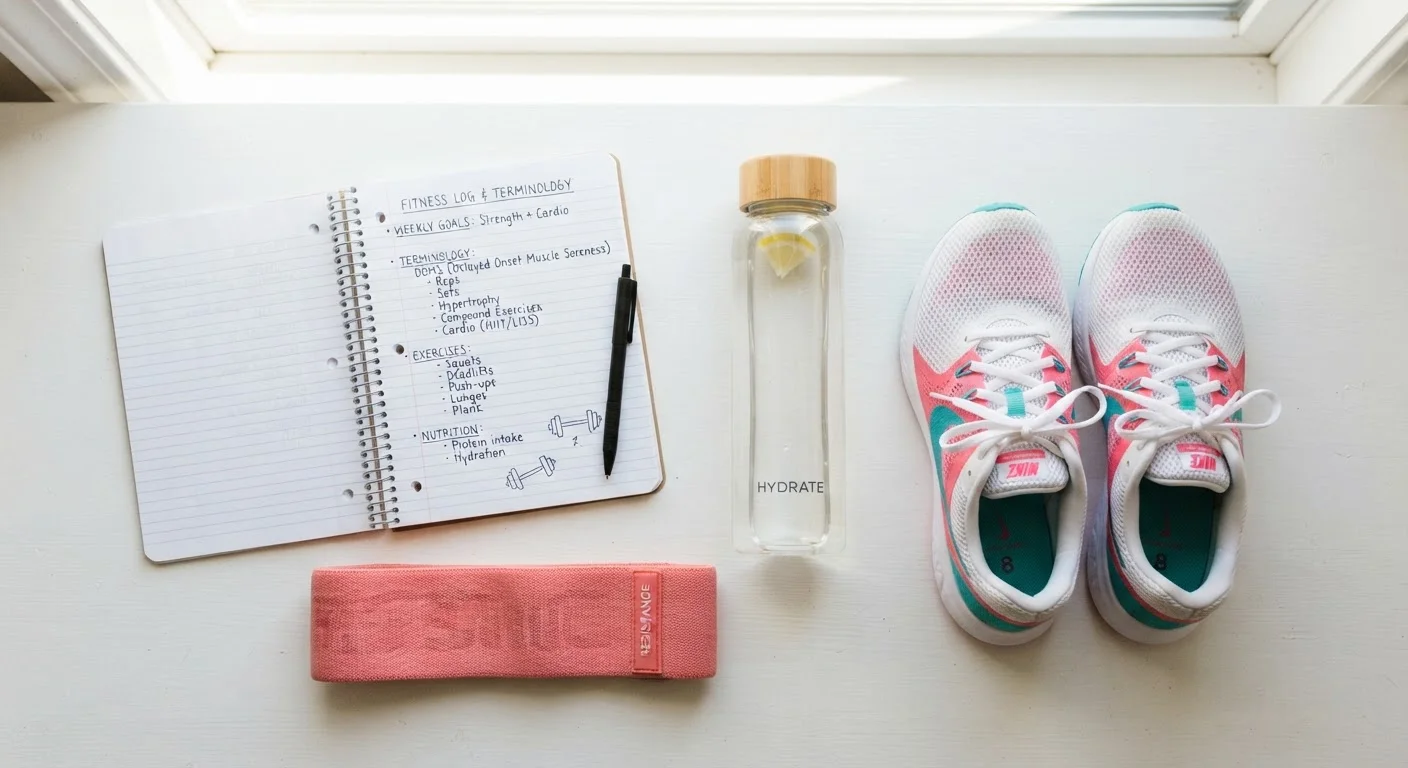
Photo: DockedReads.com | Information Made Easy editorial
Why Fitness Jargon Matters
Walking into a gym — or opening a fitness app — for the first time can feel like landing in a foreign country. Trainers talk about progressive overload, class schedules list AMRAP and EMOM, and wearables report your VO2 max. None of it needs to be intimidating. These terms exist to describe precise concepts, and once you understand them, they become useful shortcuts rather than barriers.
This reference covers the core vocabulary you'll encounter most often as a beginner. It's organized by concept area so you can dip in and out as questions arise. If you're returning to exercise after a break, having this language in your toolkit will make every article, class description, or trainer conversation easier to follow.
| Most common beginner confusion | Mixing up "reps" and "sets" |
| HIIT session length (typical) | 20–30 minutes |
| DOMS peak timing | 24–72 hours post-exercise |
| RPE scale range | 1 (very easy) to 10 (maximum effort) |
| VO2 max measured by | Oxygen consumption during peak aerobic effort |
Resistance and Strength Training Terms
Strength training has its own dense vocabulary. Here are the terms that come up constantly:
- Rep (repetition): One complete movement — one squat, one bicep curl, one push-up. Reps are the smallest unit of measurement in a workout.
- Set: A group of consecutive reps performed without resting. "3 sets of 10" means doing 10 reps, resting, then repeating twice more.
- Progressive overload: Gradually increasing the challenge on your muscles over time — by adding weight, reps, or reducing rest — so they continue to adapt. This is the core principle behind getting stronger.
- Compound movement: An exercise that works multiple muscle groups at once (e.g., squats, deadlifts, rows). Generally more time-efficient than isolation exercises.
- Isolation exercise: A movement targeting a single muscle group (e.g., a bicep curl). Often used to address specific weaknesses or imbalances.
- 1RM (one-rep max): The maximum weight you can lift for a single rep of a given exercise. Used to calculate training loads — most beginners don't need to test this directly.
Rep
A single, complete execution of an exercise movement. Counted as the basic unit in a workout set.
Set
A group of consecutive reps performed before resting. Workout instructions commonly specify total sets and reps per set.
Progressive overload
The principle of gradually increasing exercise demand — through weight, volume, or intensity — to keep prompting adaptation in the body.
HIIT
High-Intensity Interval Training. Alternates short bursts of intense effort with recovery periods. Known for cardiovascular and metabolic benefits in relatively short sessions.
DOMS
Delayed Onset Muscle Soreness. Aching or stiffness felt in muscles 24–72 hours after demanding exercise. A normal physiological response, not a measure of workout quality.
VO2 max
The maximum volume of oxygen the body can use per minute during intense exercise. A commonly cited marker of aerobic fitness capacity.
RPE
Rate of Perceived Exertion. A self-assessed scale — usually 1 to 10 — used to describe how hard a workout effort feels, independent of any device.
Deload
A deliberate period of reduced training volume or intensity, typically lasting one week, designed to allow full physiological recovery and reduce accumulated fatigue.
Cardio and Intensity Terms
Cardiovascular exercise has its own shorthand. These terms appear in class formats, training plans, and wearable dashboards:
- HIIT (High-Intensity Interval Training): Short bursts of intense effort alternated with rest or lower-intensity recovery periods. Sessions are typically 20–30 minutes. Research suggests HIIT is effective for cardiovascular fitness, but it's demanding — beginners should build a base of moderate activity first.
- LISS (Low-Intensity Steady-State): Sustained, moderate-effort cardio — like a 30-minute brisk walk or easy cycling — kept at a consistent pace throughout.
- AMRAP (As Many Reps/Rounds As Possible): A timed workout format where you complete as many reps or rounds of a circuit as you can within a set time.
- EMOM (Every Minute On the Minute): You perform a set number of reps at the start of each minute; remaining time is rest.
- VO2 max: The maximum rate at which your body can consume oxygen during exercise. It's a marker of aerobic capacity — higher values generally indicate better cardiovascular fitness. Many wearables estimate this, though those estimates vary in accuracy.
For a deeper look at what your tracker's numbers actually mean, see our guide on interpreting activity data.
Recovery, Load, and Programming Terms
Understanding how workouts are structured helps you train smarter and avoid unnecessary injury:
- Rest interval: The time taken between sets or exercises. Shorter rests (30–60 seconds) tend to increase metabolic demand; longer rests (2–3 minutes) support heavier strength work.
- Deload: A planned week of reduced training volume or intensity, allowing the body to recover and adapt before resuming heavier work.
- DOMS (Delayed Onset Muscle Soreness): Muscle aching that typically peaks 24–72 hours after unfamiliar or intense exercise. It's a normal response to muscle stress — not a sign of injury, and not required for progress.
- RPE (Rate of Perceived Exertion): A self-reported scale (typically 1–10) rating how hard an effort feels. It's a practical way to gauge intensity without equipment.
Misunderstanding recovery is one reason the "no pain, no gain" mindset can hold beginners back. Soreness and suffering are not reliable indicators of an effective session.
Not every routine needs to be high-impact. Low-impact movement uses many of these same principles and is worth understanding alongside higher-intensity formats.
A Note on Terminology Across Sources
This article is for general informational purposes only and is not a substitute for professional medical or fitness advice. Consult a qualified healthcare provider before beginning any new exercise program, especially if you have a health condition or injury.
The content on this site is for informational purposes only and is not a substitute for professional advice. Always consult a qualified professional for guidance specific to your situation.