
Common Myths About Debt That Keep People Stuck

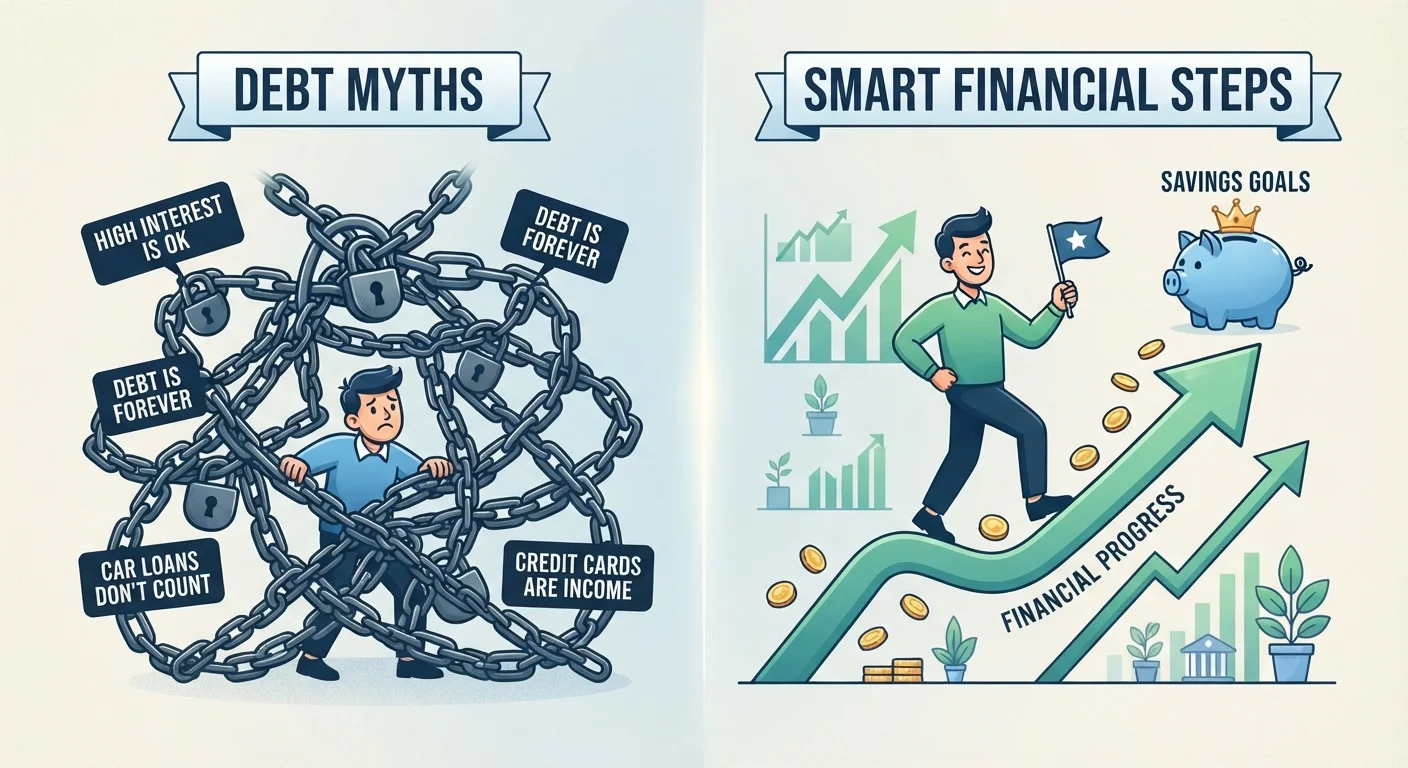
Photo: DockedReads.com | Information Made Easy editorial
Key Takeaways
- Not all debt is harmful — some forms, managed well, can support long-term financial health.
- You don't need to be debt-free before building savings; both goals can coexist.
- Ignoring debt doesn't make it disappear — interest compounds and balances grow over time.
- Closing old credit accounts can sometimes lower your credit score rather than improve it.
- Minimum payments keep accounts current but rarely reduce principal fast enough to avoid significant interest costs.
Why Debt Myths Are So Persistent
Misconceptions about debt are remarkably durable. They spread through family advice, social media, and cultural shorthand — often containing a kernel of truth wrapped in an oversimplification. The result is that many people make financial decisions based on rules of thumb that don't hold up under scrutiny.
Understanding what the evidence actually shows about debt — rather than what folklore suggests — can meaningfully change how you approach repayment, savings, and credit. The myths explored below are among the most widely held, and among the most financially costly to believe uncritically.
This article is general financial information and education, not personalised financial advice. For guidance specific to your circumstances, consult a qualified financial professional.
The Myths, Corrected
Each of the following misconceptions is one that financial counsellors regularly encounter. Clearing them up isn't about being contrarian — it's about building a more accurate mental model so your decisions are grounded in reality.
Myth
All debt is bad and should be avoided at all costs.
Fact
Debt is a financial tool. Its impact depends on the type, interest rate, and how it is managed — not its existence alone.
Lumping all debt together ignores a fundamental distinction: some debt funds assets that can appreciate or generate income (a mortgage, a student loan for a high-demand field), while other debt funds consumption at a high cost (revolving credit card balances). The interest rate and terms matter enormously. A low fixed-rate mortgage used to purchase a home is structurally very different from a 25% APR credit card balance. Treating them identically leads to poor trade-offs, such as paying down a 3% mortgage aggressively while carrying a 20% card balance.
Myth
You need to be completely debt-free before you start saving money.
Fact
Building savings and repaying debt can — and in most cases should — happen at the same time.
The all-or-nothing approach to debt repayment leaves people without a financial cushion. Without any savings, the first unexpected expense typically results in more borrowing, often at a high interest rate. A small emergency fund — even a few hundred dollars — acts as a buffer that prevents the repayment cycle from being constantly reset by life's normal surprises. Most financial planning frameworks recommend maintaining at least a minimal liquid reserve even while aggressively paying down high-interest debt.
Myth
Paying the minimum each month means you're handling your debt responsibly.
Fact
Minimum payments satisfy the lender's requirement but allow interest to compound, often stretching a balance into years of additional cost.
Credit card minimum payments are typically structured as a small percentage of the outstanding balance or a flat fee — whichever is greater. This design means that for a large balance at a high interest rate, a minimum payment may barely cover the interest accrued that month. The principal reduces slowly, and the total amount paid over time can substantially exceed the original balance. Responsible debt management means paying more than the minimum whenever possible, prioritising high-rate balances first.
Myth
Closing old credit card accounts will improve your credit score.
Fact
Closing old accounts often reduces your available credit and can shorten your credit history, which typically lowers your score.
Credit utilisation — the ratio of your current balances to your total available credit — is one of the most significant factors in most credit scoring models. Closing an account reduces your total available credit, which raises your utilisation ratio if you carry any balances. Additionally, the age of your credit accounts contributes to your score; removing an older account shortens your average account age. In most cases, keeping old accounts open (and ideally carrying no balance) is better for your credit profile than closing them.
Myth
Debt settlement is a good alternative to bankruptcy and has no lasting consequences.
Fact
Debt settlement can result in significant credit damage, potential tax liability on forgiven amounts, and is not appropriate for every situation.
When a creditor agrees to accept less than the full amount owed, the forgiven portion may be reported to the IRS as cancellable debt income, which can create an unexpected tax bill. Settled accounts are also typically reported as settled for less than the full amount on your credit report, which is treated negatively by future lenders. While debt settlement may be appropriate in specific circumstances — usually as an alternative when bankruptcy is also being considered — it is not a cost-free solution. Anyone evaluating it should consult a qualified credit counsellor or attorney first.
For a broader look at how some of these patterns show up in investing decisions too, see investing myths that keep ordinary people on the sidelines.
What the Evidence Suggests About Paying Down Debt and Saving Simultaneously
One of the most consequential myth-driven choices people make is waiting until they are completely debt-free before saving a single dollar. The problem: if you carry debt for years before starting an emergency fund, any unexpected expense — a medical bill, a car repair — sends you straight back to borrowing.
~40%
US adults who carry credit card debt month to month
Federal Reserve surveys consistently find that roughly four in ten US adults carry a balance on at least one credit card from month to month, underscoring how common revolving debt management decisions are.
$400
Liquid savings buffer that reduces new borrowing risk
Federal Reserve research has found that many adults who cannot cover a $400 emergency without borrowing are at significantly higher risk of entering or deepening a debt cycle following an unexpected expense.
Research in behavioural economics consistently shows that people who build even a modest emergency buffer while repaying debt are less likely to accumulate new high-interest balances after a financial shock. The two goals are not mutually exclusive.
Paying off debt while saving money at the same time explores the practical trade-offs in depth. And if you want to accelerate repayment without waiting for a raise, strategies for paying down debt faster without increasing income covers evidence-informed approaches.
High-Interest Debt Demands Priority
For situations where holding some debt alongside savings can actually be the rational choice — for example, when a low fixed-rate loan coexists with a higher-yield savings account — see situations where carrying some debt can be a rational choice.
Building Better Habits From Accurate Beliefs
Correcting a myth is only half the work. The other half is replacing the old belief with a habit that reflects the accurate picture. If you now know that all-or-nothing thinking about debt is counterproductive, the practical follow-through is to create a written plan that allocates money to both repayment and savings — even if the savings contribution starts small.
Budgeting myths that keep people from starting is worth reading alongside this piece, since many debt myths and budgeting myths reinforce each other. Clearing up both sets of misconceptions at once tends to have a compounding effect on financial confidence and follow-through.
Be Cautious of Debt Relief Companies
The content on this site is for informational purposes only and is not a substitute for professional advice. Always consult a qualified professional for guidance specific to your situation.